
Grafana OnCall vs Regen
Grafana OnCall's open-source edition entered maintenance mode on March 11, 2025 and is archived on March 24, 2026. After that date, cloud-connected features on the OSS build, including mobile push, SMS and voice notifications, stop working, and the GitHub repository moves to a read-only mirror. Grafana's own guidance is to migrate to Grafana Cloud IRM, a hosted product with its own, usage-metered pricing.
Regen is FluidifyAI's self-hosted alternative to PagerDuty and incident.io. It's open source and free to self-host, or a flat $100 a month on the Pro plan, with no per-seat pricing and no product sunset to plan around. This is a comparison of Regen specifically, not the rest of the FluidifyAI suite.
What maintenance mode means in practice
During maintenance mode, Grafana is only committing to fix critical bugs and CVEs scoring 7.0 or higher. Everything else, new features, smaller fixes, active development, has moved to Grafana Cloud IRM instead. Teams running the OSS build today are on a project that stops receiving cloud connectivity in 2026 and general development well before that.
Regen ships open source and self-hosted by default, and isn't being wound down or folded into a paid successor.
What's actually included
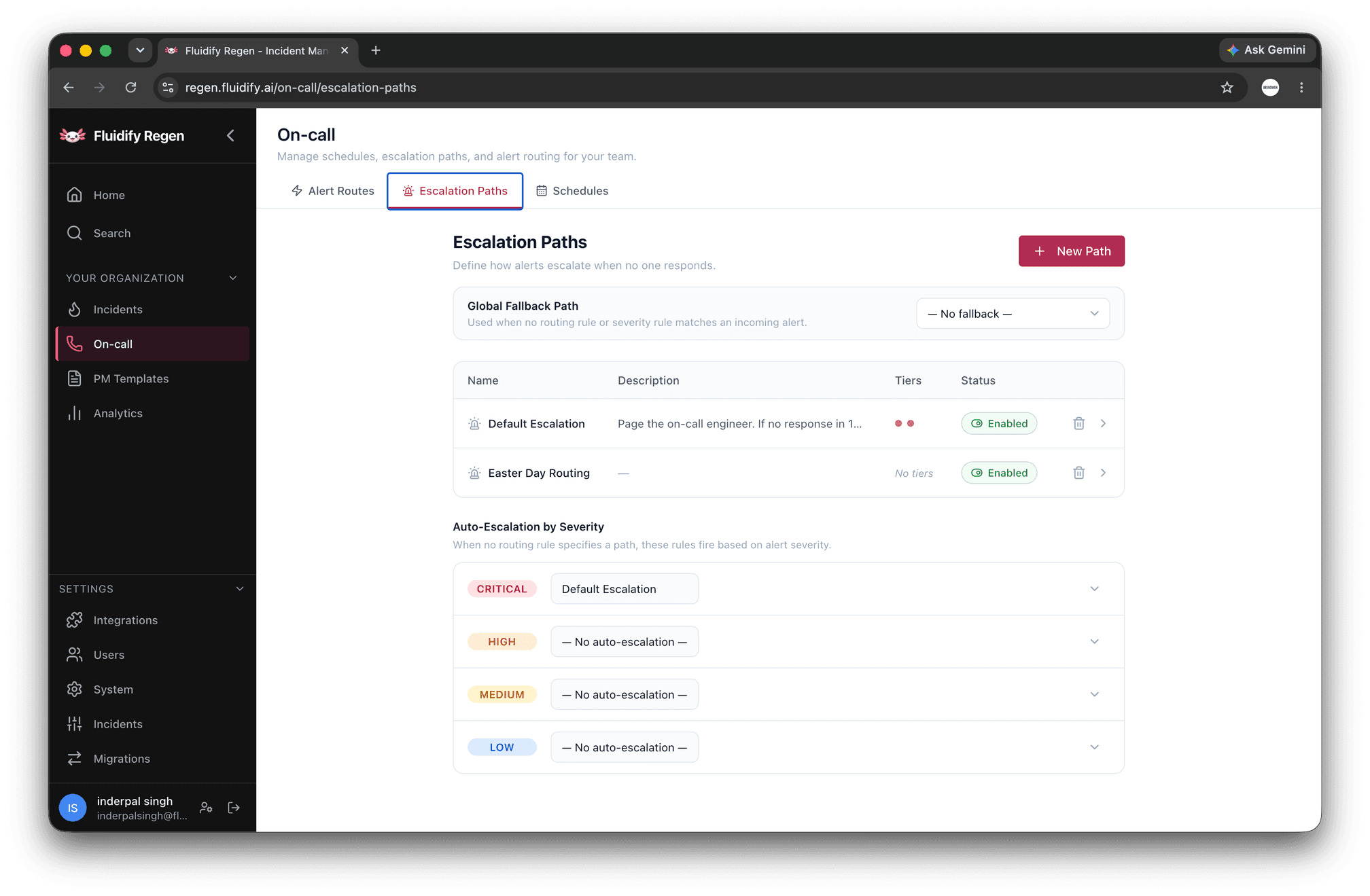
Grafana OnCall's escalation chains support the mechanics that matter: pausing before the next step, notifying an individual or group, notifying whoever's on a schedule, or notifying the whole team, triggered until someone acknowledges. Its real advantage is native integration with Grafana's own dashboards and alerting, which is a genuine strength for a team already standardized on Grafana for observability.
Regen covers the same escalation mechanics with multi-step timeouts, plus alert ingestion from Prometheus Alertmanager, Grafana, AWS CloudWatch and generic webhooks, on top of Prometheus, Grafana, Datadog, Slack, Teams and 700+ other integrations, not scoped to one observability vendor. On-call schedules support rotations, overrides, holidays, exceptions and leave, with global timezone support and multi-lingual interfaces, including Chinese.
Pricing after the sunset
Grafana Cloud IRM's free tier covers 3 active IRM users a month, then charges $20 per additional active user on Pro. An 'active user' is anyone in an on-call schedule or escalation chain, or anyone who received a page, or created or updated an incident that month, by Grafana's own definition. That means the bill moves with how bad the month was: a 15-person team where everyone touches an incident is 12 billable users past the free 3, about $240 that month; a quiet month with 5 active people is $40. Enterprise starts at a $25,000 a year minimum commitment.
Regen's Pro plan is a flat $100 a month regardless of how many people are active in a given month, with no per-user metering and no cap on incidents, schedules or AI usage. The open-source tier runs the same way self-hosted, at $0.
Migration
Regen imports schedules, escalation policies and users with one-click migration from Grafana OnCall, PagerDuty and Opsgenie. Teams don't have to rebuild their on-call configuration by hand before the March 24, 2026 archive date, or decide under time pressure whether to move to Grafana Cloud IRM instead.
Deployment and reliability
Grafana OnCall OSS was free and self-hosted, same as Regen's Free tier, but that path ends at archival: Grafana's supported route forward is the hosted Grafana Cloud IRM, not a continuation of the self-hosted product. Regen's Free tier stays open source and self-hosted with no end date, and the Helm chart runs non-root (UID 1001) with a read-only root filesystem and every Linux capability dropped, none of it behind a paid tier, documented in the repo's SECURITY.md.
Regen also publishes its own load-test and chaos-test numbers rather than a marketed SLA figure: webhook ingestion p99 under 10 ms, tested to a peak of 3,917 RPS with zero 5xx errors, an 11-second Patroni Postgres failover RTO and a 5-second Redis failover RTO, documented with the test scripts in RELIABILITY.md.
Notifications, chat and mobile
This is the sharpest edge of the sunset: mobile push, SMS and phone-call notifications on Grafana OnCall OSS run through Cloud Connection, and Cloud Connection support ends at archival, taking those notification channels with it. Teams on the OSS build who don't migrate lose more than updates, they lose ways to actually get paged.
Regen's Slack integration covers channels, bot commands and live timeline sync; Microsoft Teams gets Adaptive Cards and bot commands the same way. Beyond chat, Regen pages through Telegram, mobile push notifications on Android and iOS over Firebase Cloud Messaging, Twilio for voice and SMS, and a dedicated Android/iOS on-call app, none of it tied to a sunset date.
Evaluating Regen against Grafana OnCall?
We'll walk through the exact comparison with you - feature by feature.