
Hyperping vs Regen
Hyperping's pricing today runs by monitor count with seat caps layered on top, not the flat monitor-only story its marketing leads with: Free is $0 for 20 monitors and 1 seat with no on-call features at all, Essentials is $29 a month ($24 annually) for 50 monitors, 2 seats and on-call plus escalation policies, Pro is $89 a month ($74 annually) for 100 monitors, 5 seats and phone-call alerts, and Business is $299 a month ($249 annually) for 1,000 monitors, 15 seats, SSO and audit logs. Every tier caps included seats and charges $7 to $12 a month for each additional one. Its on-call layer has also grown up since it launched: multi-layer rotation schedules with timezone-aware overrides, business-hours versus after-hours escalation paths, and a free blameless post-mortem generator with MTTA/MTTR tracking, not just a bare escalation chain.
Regen is FluidifyAI's self-hosted alternative to PagerDuty and incident.io. It's open source and free to self-host, or a flat $100 a month on the Pro plan, with no monitor count or seat count to plan around. This is a comparison of Regen specifically, not the rest of the FluidifyAI suite, and not a claim that Regen replaces Hyperping's uptime monitoring, since it doesn't run its own checks.
What's actually included
Hyperping's core is real, credible uptime and synthetic monitoring: HTTP, TCP, DNS, SSL, keyword, cron and Playwright-based browser checks from 18 global locations, plus branded, multi-tenant status pages. Its on-call layer, gated behind the Essentials tier and up, now supports calendar-based schedules with multiple rotation layers, timezone coordination and temporary overrides, and escalation policies that can route through email, SMS, phone and Slack in sequence with different paths for business hours versus after-hours. It also tracks acknowledgment times and offers a free blameless post-mortem generator, which is more incident tooling than a pure status-page product typically ships.
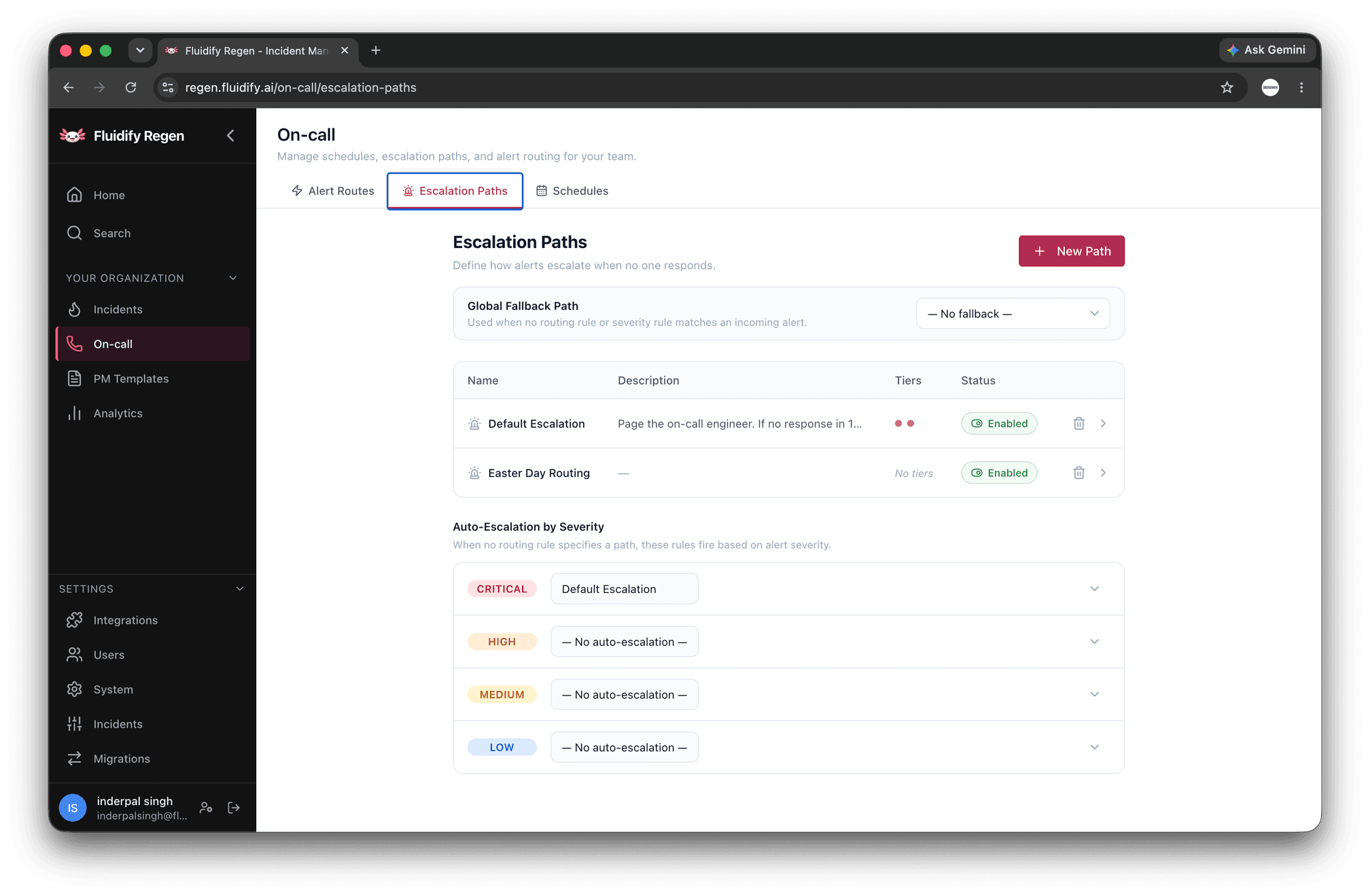
Regen is built around the incident record itself rather than the monitor: an incident lifecycle with an immutable timeline, escalation policies with multi-step timeouts, and alert ingestion from Prometheus Alertmanager, Grafana, AWS CloudWatch and generic webhooks, on top of Prometheus, Grafana, Datadog, Slack, Teams and 700+ other integrations. On-call schedules support rotations, overrides, holidays, exceptions and leave, with global timezone support on every tier and a multi-lingual interface on SaaS and Enterprise.
Pricing, seats and monitor limits
On-call isn't available on Hyperping's Free plan at all. It first appears on Essentials at $29 a month, and every paid tier includes a fixed number of seats before per-seat overage kicks in: 2 included on Essentials at $7 a month per extra seat, 5 on Pro at $9, and 15 on Business at $12, according to Hyperping's own pricing page. Phone-call alerts specifically are a Pro-tier feature and up, not included on Essentials.
Run a 50-person on-call team through Business, since that's the tier with SSO and audit logs: $249 a month annually plus 35 extra seats at $12 each is $669 a month, about $8,028 a year. Regen includes SSO on every tier, so the same team doesn't need to move off Pro for it: $100 a month flat, about $1,200 a year, with no seat count to plan around. The open-source tier runs the same way self-hosted, at $0.
Self-hosted in under five minutes
Hyperping has no self-hosted or open-source option; the closest it publishes is an open-source Terraform provider for managing Hyperping's cloud account as code, not the product itself. Regen ships open source under AGPLv3 and deploys across five surfaces: self-hosted VPC, on-prem, private cloud, air-gapped, and cloud SaaS, with a one-command Docker Compose or Kubernetes install that runs in under 5 minutes.
There's no dedicated Hyperping importer in Regen's migration list; that covers Grafana OnCall, Opsgenie and PagerDuty schedules and escalation policies specifically. Moving an on-call setup off Hyperping means rebuilding rotations and escalation policies by hand in Regen, which is a real cost worth weighing, offset somewhat by how fast the rest of the deployment is.
Security, compliance and reliability
Hyperping is upfront that it doesn't hold its own certifications: its security page states plainly that Hyperping itself does not hold independent SOC 2 or ISO 27001 certifications, and leans on the SOC 2 and ISO 27001 status of its infrastructure providers, DigitalOcean, AWS, Cloudflare and Vercel, instead. It does commit to GDPR as a French company with EU-based storage, TLS 1.2+ in transit and LUKS disk encryption at rest.
Regen ships with its own documented security posture rather than borrowing a vendor's: the Helm chart runs non-root (UID 1001), with a read-only root filesystem and every Linux capability dropped, documented in the repo's SECURITY.md. It's also built to SOC 2, GDPR, DPDPA, EU AI Act and HIPAA guidelines, with SSO and SAML 2.0 for Okta, Azure AD, Google Workspace and any compliant identity provider included free on every tier, where Hyperping gates SSO to the $249-a-month Business tier.
Regen also publishes its own load-test and chaos-test numbers: webhook ingestion p99 under 10 ms, tested to a peak of 3,917 RPS with zero 5xx errors, an 11-second Patroni Postgres failover RTO and a 5-second Redis failover RTO, documented with the test scripts in RELIABILITY.md. Hyperping doesn't publish comparable load-test or failover numbers for its own platform.
Notifications and alert channels
Hyperping alerts over email, SMS, phone calls, Slack, Discord, Telegram, Microsoft Teams, Google Chat, PagerDuty, Opsgenie, webhooks and Intercom, which is a genuinely wide channel list for a monitoring product. Phone-call alerts require Pro or above; Essentials only gets email, SMS, Slack and webhook-class channels.
Regen covers Slack (channels, bot commands, live timeline sync), Microsoft Teams (Adaptive Cards, bot commands), Telegram on every tier including the open-source one, mobile push over Firebase Cloud Messaging on Android and iOS also on every tier, and Twilio voice/SMS plus a dedicated Android/iOS on-call app on SaaS and Enterprise. None of it is gated behind a per-seat or per-monitor tier the way Hyperping's phone alerts are.
AI and automation
Hyperping's post-incident tooling is a free blameless post-mortem generator paired with MTTA/MTTR tracking; nothing on its site or docs describes it as AI-generated, and no AI-assisted incident summarization feature is published anywhere on hyperping.com as of this writing.
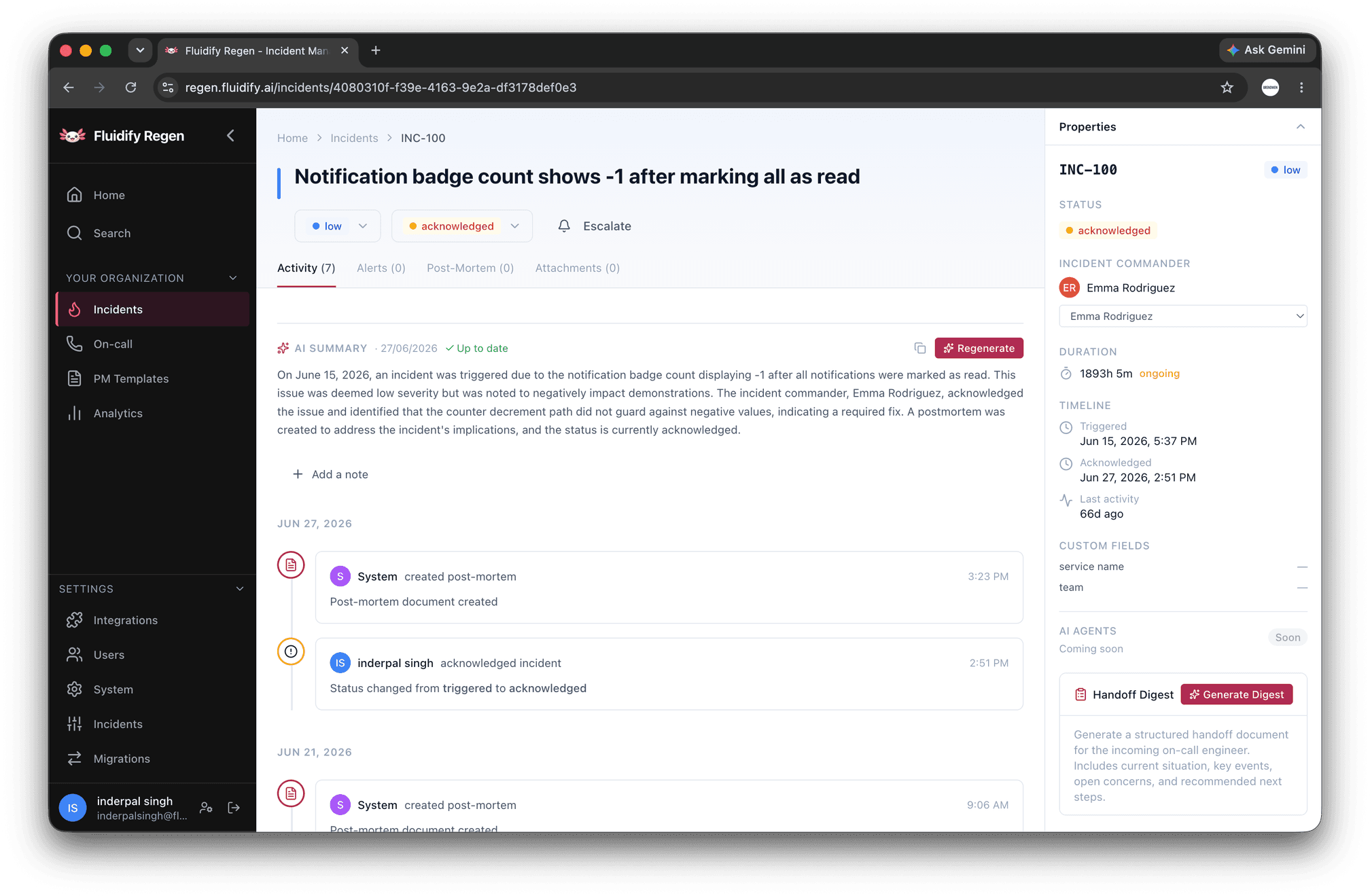
Regen's AI is built into the product: incident summaries, post-mortems and handoff digests generated automatically and synced back to Slack and Teams, plus pattern matching that learns from historical incidents. It runs on a model key brought by the team, OpenAI, Anthropic or Ollama, included free on every tier rather than metered or reserved for a top plan.
Evaluating Regen against Hyperping?
We'll walk through the exact comparison with you - feature by feature.