
PagerDuty vs Regen
PagerDuty charges per seat, then meters AI on top of that: Professional includes 1,000 one-time AI Actions, Business 5,000, and the deeper AI products, AIOps and Advance, are separate subscriptions layered on top of whichever seat tier you're on. Regen doesn't cap users, incidents, schedules or AI usage on any tier. Alerting, on-call and AI assist are the product, not a metered add-on.
Regen is FluidifyAI's self-hosted alternative to PagerDuty and incident.io. It's open source and free to self-host, or a flat $100 a month on the Pro plan, with no per-seat pricing. This is a comparison of Regen specifically, not the rest of the FluidifyAI suite.
What's actually included
PagerDuty's Enterprise tier ships a mature workflow engine: incident workflows with conditionals, loops and delays, up to 100 custom incident types, and 750+ integrations built up over more than a decade. That depth is real, and it's a large part of why PagerDuty has stayed the default for large incident response teams for as long as it has.
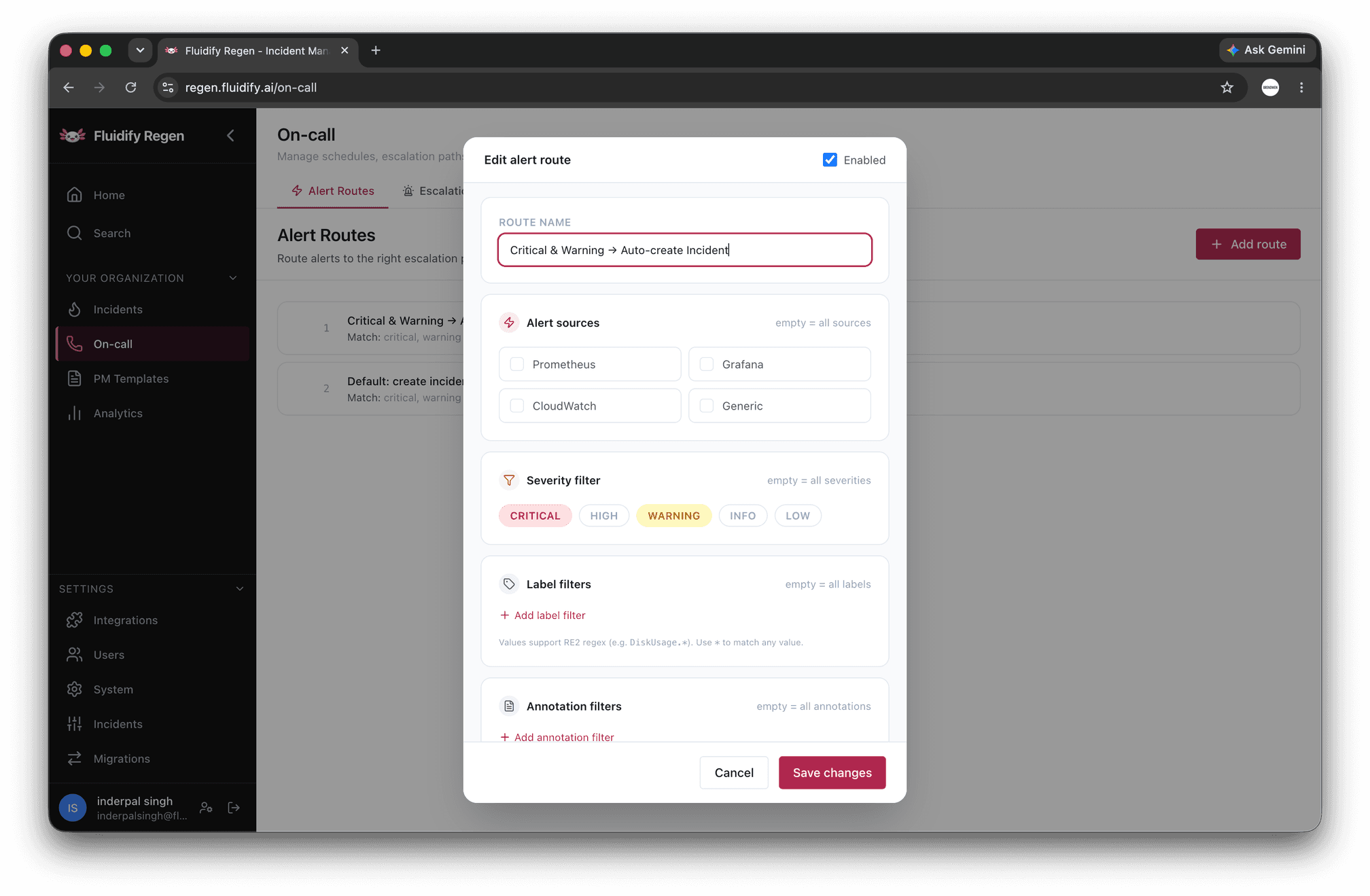
Regen covers the same core mechanics: an incident lifecycle with an immutable timeline, escalation policies with multi-step timeouts, and alert ingestion from Prometheus Alertmanager, Grafana, AWS CloudWatch and generic webhooks, on top of Prometheus, Grafana, Datadog, Slack, Teams and 700+ other integrations. On-call schedules support rotations, overrides, holidays, exceptions and leave, with global timezone support and multi-lingual interfaces, including Chinese.
Pricing and limits
PagerDuty's Free tier caps out at 5 users and 100 international phone/SMS notifications a month. Past that, Professional and Business are both billed per seat, and Enterprise drops the published price for a sales conversation. Run the math on a 50-person team on Business, annual billing: 50 seats at $41 is $2,050 a month. Add AIOps at $699 a month annually and Advance at roughly $415, and the same team is paying close to $3,164 a month, about $38k a year, before any per-event AIOps overage.
Regen's Pro plan is a flat $100 a month for that same 50-person team, about $1,200 a year, with no per-seat multiplier and no cap on users, incidents, schedules or AI usage. The open-source tier runs the same way self-hosted, at $0.
Migration
Regen imports schedules and escalation policies with one-click migration from PagerDuty, Opsgenie and Grafana OnCall. An existing PagerDuty rotation doesn't have to be rebuilt by hand to try it.
Deployment, security and reliability
PagerDuty's core incident management platform is cloud-only. The one self-hosted product it sells is Runbook Automation Self-Hosted, a separate single-tenant automation add-on, not the on-call and paging platform itself. Regen ships open source and self-hosted by default: the Helm chart runs non-root (UID 1001), with a read-only root filesystem and every Linux capability dropped, none of it behind a paid tier, documented in the repo's SECURITY.md.
Regen ships SSO and SAML 2.0 for Okta, Azure AD, Google Workspace and any compliant identity provider. PagerDuty gates SSO behind Professional and above; it isn't available on the Free tier at all.
Regen also publishes its own load-test and chaos-test numbers rather than a marketed SLA figure: webhook ingestion p99 under 10 ms, tested to a peak of 3,917 RPS with zero 5xx errors, an 11-second Patroni Postgres failover RTO and a 5-second Redis failover RTO, documented with the test scripts in RELIABILITY.md. PagerDuty publishes uptime on its own status page, but not the load-test methodology behind it, so there's nothing to compare Regen's reproducible numbers against directly.
Notifications, chat and mobile
Regen's Slack integration covers channels, bot commands and live timeline sync; Microsoft Teams gets Adaptive Cards and bot commands the same way. Beyond chat, Regen pages through Telegram, mobile push notifications on Android and iOS over Firebase Cloud Messaging, Twilio for voice and SMS, and a dedicated Android/iOS on-call app.
PagerDuty's Free tier caps phone and SMS notifications at 100 a month, one of the limits that pushes teams onto a paid seat early. Regen doesn't gate notification channels behind a tier.
AI and automation
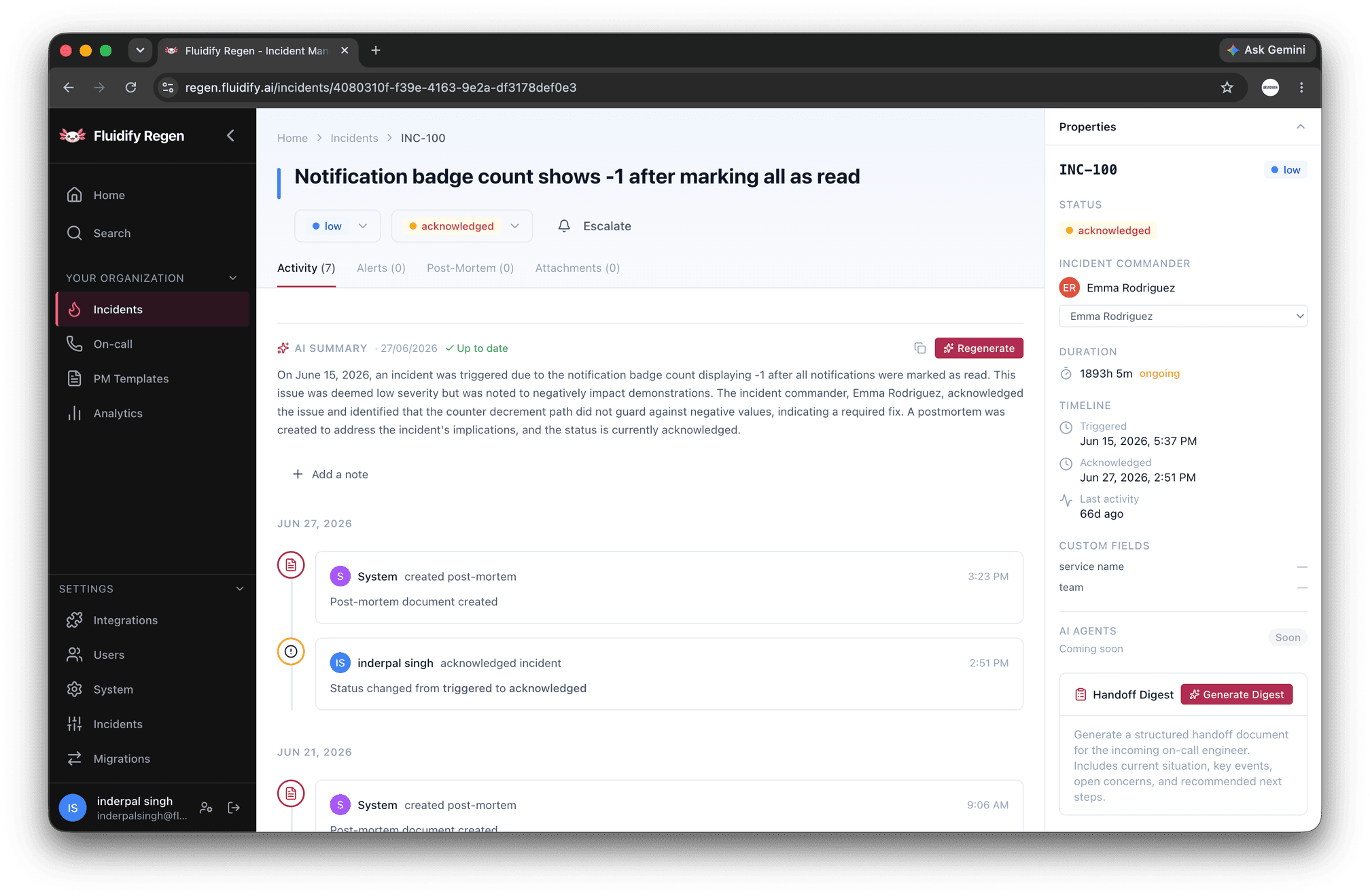
Regen's AI is built into the product: incident summaries, post-mortems and handoff digests generated automatically and synced back to Slack and Teams, plus pattern matching that learns from historical incidents. It runs on a model key you bring yourself, OpenAI, Anthropic or Ollama, and isn't billed by the action.
PagerDuty's AI is three separate meters instead: AI Actions bundled per seat tier, AIOps billed on top by accepted event, and Advance billed on top again for the generative features, and AIOps specifically requires a paid seat before you're allowed to buy it.
Evaluating Regen against PagerDuty?
We'll walk through the exact comparison with you - feature by feature.