
Opsgenie vs Regen
Atlassian stopped selling Opsgenie on June 4, 2025, and support for existing accounts ends April 5, 2027, after which unmigrated data is deleted. Atlassian's own path forward is Jira Service Management, not a continuation of Opsgenie's model: matching Opsgenie Standard's feature set requires JSM Premium, about a 158 percent increase in per-agent cost, and the migration itself doesn't carry over cleanly: chat integrations have to be manually reconnected, phone numbers don't transfer, and bidirectional integrations only work on Premium and Enterprise plans. If you're evaluating on-call tools today, Opsgenie is a shrinking runway attached to a more expensive destination, not a long-term platform.
Regen is FluidifyAI's self-hosted alternative to PagerDuty and Opsgenie. It's open source and free to self-host, or a flat $100 a month on the Pro plan, with no per-seat pricing and no end-of-sale notice attached to it. This is a comparison of Regen specifically, not the rest of the FluidifyAI suite.
What's actually included
Opsgenie's real strength, while it was being sold, was depth built up over more than a decade inside Atlassian's ecosystem: mature escalation and routing logic, tight Jira integration, and more than 200 integrations across monitoring, chat and ITSM tools. That depth is real, and it's a large part of why Opsgenie stayed the default for teams already living inside Jira and Confluence.
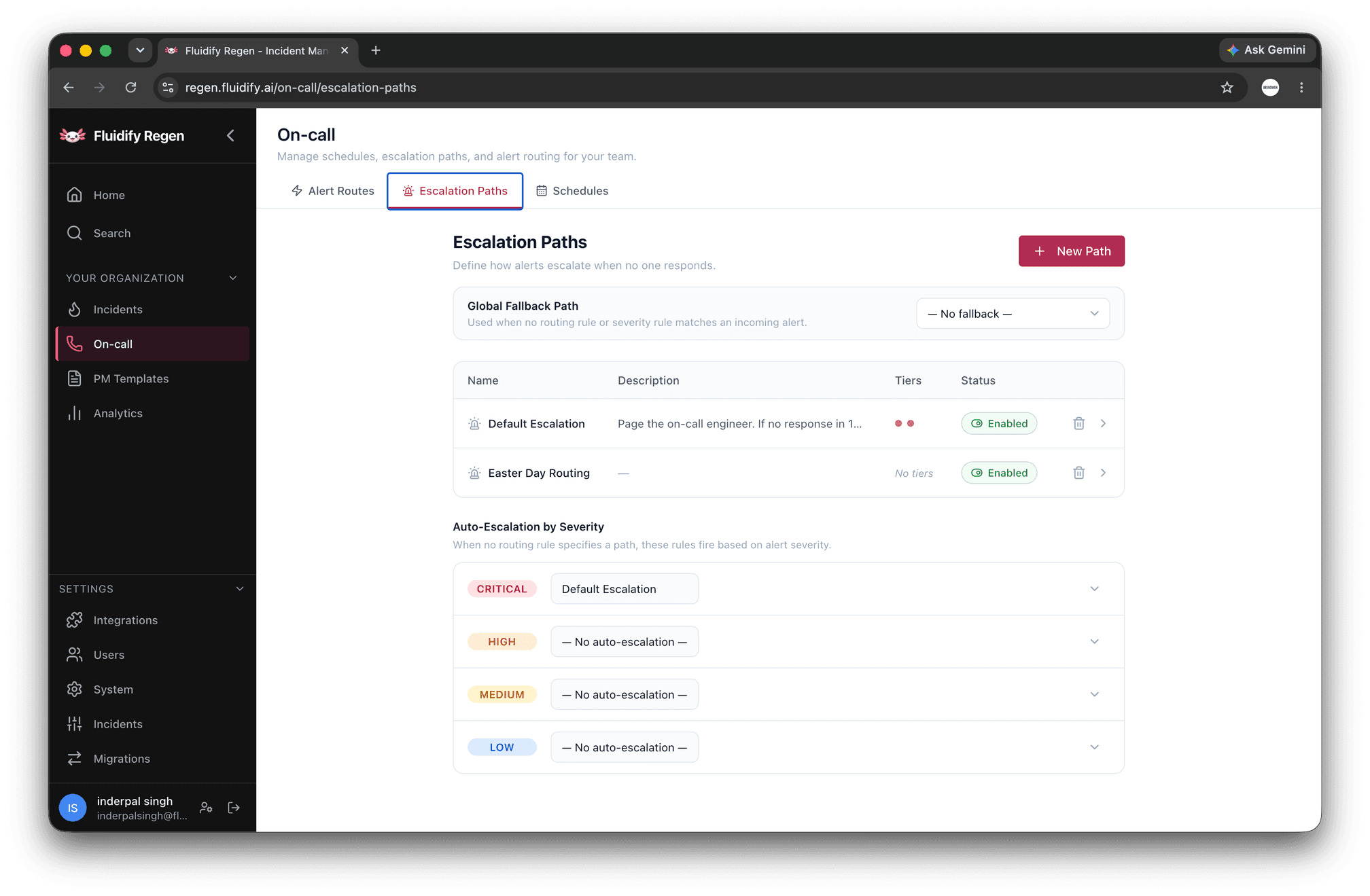
Regen covers the same core mechanics on its own: an incident lifecycle with an immutable timeline, escalation policies with multi-step timeouts on every tier, not gated to a specific plan, and alert ingestion from Prometheus Alertmanager, Grafana, AWS CloudWatch and generic webhooks, on top of Prometheus, Grafana, Datadog, Slack, Teams and 700+ other integrations. On-call schedules support rotations, overrides, holidays, exceptions and leave, with global timezone support on every tier and a multi-language interface on the SaaS and Enterprise tiers.
Where Opsgenie's pricing was, before the sunset
For reference, Opsgenie's tiers were $0 for up to 5 users on Free, $9.45 a seat monthly on Essentials (annual), $19.95 on Standard, and $31.90 on Enterprise, each with a higher monthly-billed price on top. Escalation policies and unlimited integrations weren't available below Standard, according to a feature comparison from AlertOps, and SAML SSO needed Standard or Enterprise; it wasn't available on Free or Essentials at all. A 50-person team on Standard alone was close to $12,000 a year before Atlassian stopped selling it.
Regen's Pro plan is a flat $100 a month for that same 50-person team, about $1,200 a year, with no per-seat multiplier and no cap on users, incidents, schedules or AI usage. The open-source tier runs the same way self-hosted, at $0.
What Atlassian wants existing customers to migrate to
Atlassian's own migration path for Opsgenie customers is Jira Service Management, priced at $20 a seat monthly on Standard and $51.42 on Premium, both billed annually. JSM Standard doesn't include the post-incident analysis and stakeholder notifications that were part of Opsgenie Standard: matching that feature set requires JSM Premium, about a 158 percent increase over Opsgenie Standard pricing, and up to 444 percent over Opsgenie Essentials.
The migration itself carries its own list of caveats, all documented by Atlassian. Chat integrations for Slack and Microsoft Teams aren't automatically migrated and have to be manually reconnected and re-enabled. Bidirectional integrations only work on JSM Premium and Enterprise, so teams staying on Standard lose outgoing sync. Opsgenie's own phone numbers don't carry over at all, and about two dozen older integrations, including Campfire, XMPP and Stackdriver, aren't supported going forward. For a wider look at where other teams are evaluating a move, FluidifyAI has a breakdown of the other Opsgenie alternatives on the market.
Migration
Regen ships a one-click Opsgenie schedule and escalation policy import, so a team moving off Opsgenie lands directly in Regen's own on-call model in one step, instead of a second migration into an Atlassian product with a steeper price tag and its own list of manual reconfiguration work to finish before April 2027.
Deployment, security and reliability
Opsgenie was cloud-only, with no self-hosted option at any tier. Regen ships open source and self-hosted by default, across five surfaces: self-hosted VPC, on-prem, private cloud, air-gapped and cloud SaaS. The Helm chart runs non-root (UID 1001), with a read-only root filesystem and every Linux capability dropped, none of it behind a paid tier, documented in the repo's SECURITY.md.
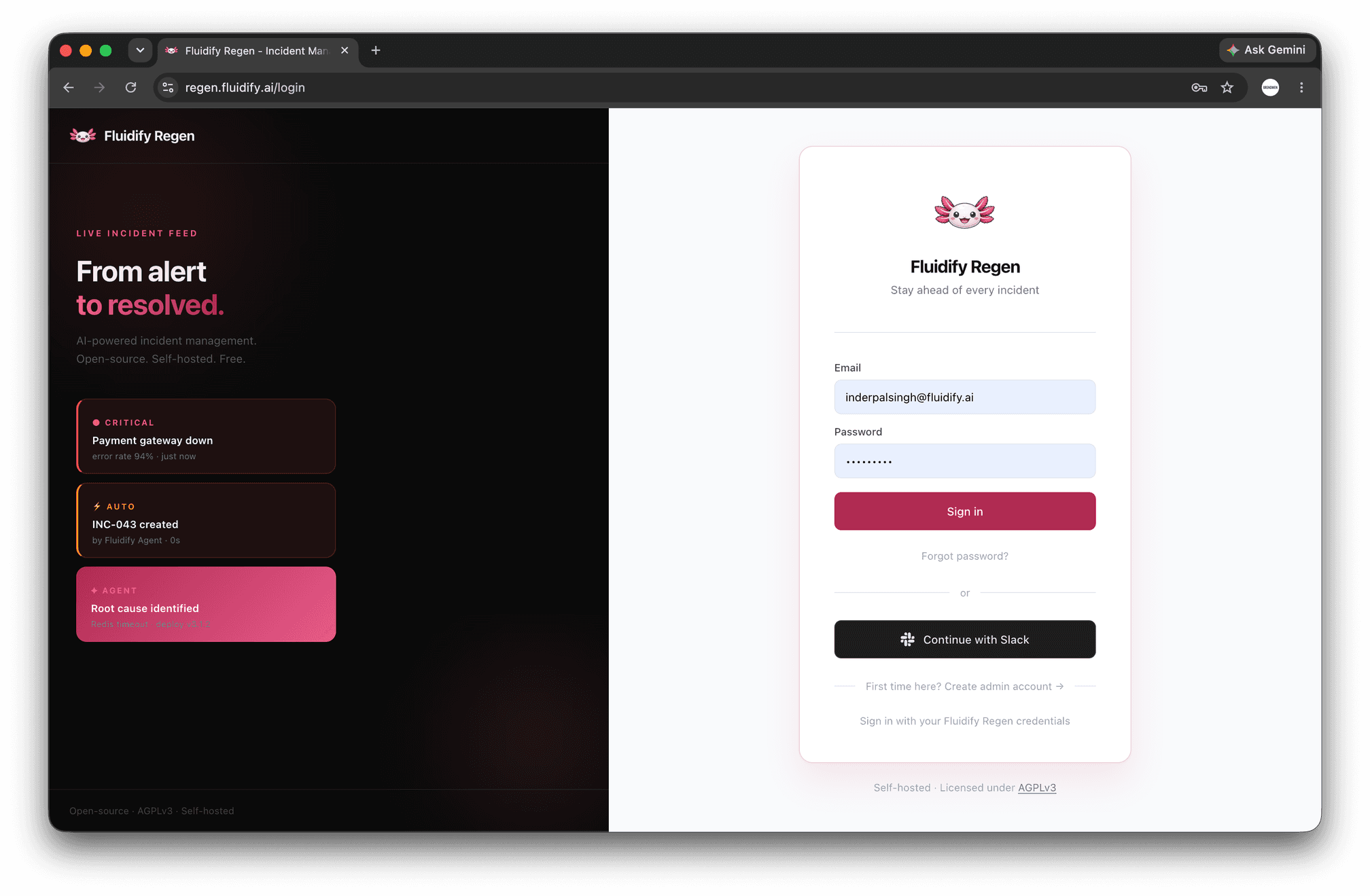
Regen ships SSO and SAML 2.0 for Okta, Azure AD, Google Workspace and any compliant identity provider on every tier, including the free self-hosted one. Opsgenie required a Standard or Enterprise plan for SAML SSO; it wasn't available on Free or Essentials.
Regen also publishes its own load-test and chaos-test numbers rather than a marketed SLA figure: webhook ingestion p99 under 10 ms, tested to a peak of 3,917 RPS with zero 5xx errors, an 11-second Patroni Postgres failover RTO and a 5-second Redis failover RTO, documented with the test scripts in RELIABILITY.md. Atlassian's own Opsgenie status page shows historical uptime, but not the load-test methodology behind it, so there's nothing to compare Regen's reproducible numbers against directly.
Notifications, AI and automation
Regen's Slack integration covers channels, bot commands and live timeline sync; Microsoft Teams gets Adaptive Cards and bot commands the same way. Beyond chat, Regen pages through Telegram on every tier including the open-source one, mobile push notifications on Android and iOS over Firebase Cloud Messaging, Twilio for voice and SMS, and a dedicated Android/iOS on-call app on the SaaS and Enterprise tiers.
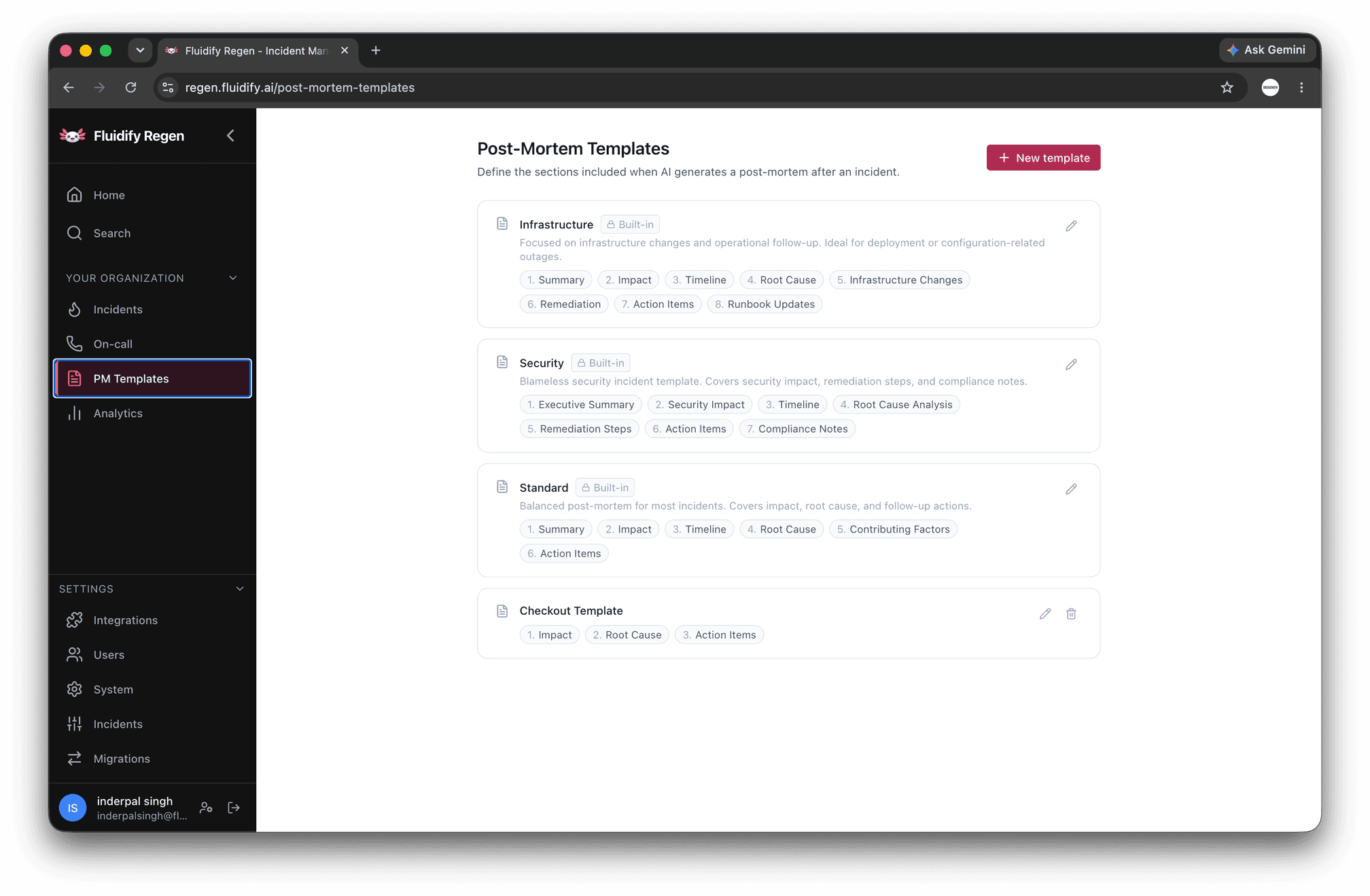
Regen's AI is built into the product: incident summaries, post-mortems and handoff digests generated automatically and synced back to Slack and Teams, plus pattern matching that learns from historical incidents. It runs on a model key you bring yourself, OpenAI, Anthropic or Ollama, and isn't billed by the action. Opsgenie itself never shipped native generative AI features; Atlassian's AI investment went into JSM's separate AIOps tier instead, gated to Premium and above.
Sources
- Atlassian Opsgenie pricing and end-of-sale notice
- Atlassian Opsgenie integrations page
- Atlassian Opsgenie on-call management and escalations
- Opsgenie SAML SSO docs (Atlassian)
- AlertOps Opsgenie feature comparison
- Atlassian: integrations after migration
- Jira Service Management pricing breakdown 2026 (Spike)
- Opsgenie status page (Atlassian)
- Regen SECURITY.md
- Regen RELIABILITY.md
- FluidifyAI pricing
- FluidifyAI integrations
- FluidifyAI blog: top 5 Opsgenie alternatives 2026
Evaluating Regen against Opsgenie?
We'll walk through the exact comparison with you - feature by feature.