
FireHydrant vs Regen
FireHydrant's free tier caps out at 10 responders, and real usage starts on the Pro plan at $25 per responder per month, billed annually, with alerting and on-call sold as a separate product, Signals, billed by alert volume rather than by responder. Vendr's aggregated data across 43 tracked deals puts the median annual FireHydrant contract at $33,195, ranging from $14,477 to $69,862. The feature most teams actually want, AI-drafted retrospectives, is reserved for the Enterprise tier, the same tier that gates SCIM, audit logs and private incidents, so a Pro customer paying per responder still has to open a sales conversation to get it.
Regen is FluidifyAI's self-hosted alternative to FireHydrant, PagerDuty and Opsgenie. It's open source and free to self-host, or a flat $100 a month on the Pro plan, with no per-seat or per-responder pricing on any tier and no separate product to buy for on-call. This is a comparison of Regen specifically, not the rest of the FluidifyAI suite.
What FireHydrant actually does well
FireHydrant's pitch is process standardization, and it delivers on it. Declaring an incident triggers automated role assignment, runbook execution and retrospective templates rather than leaving a human to remember the checklist, and the platform ships public status pages on every tier, from 1 on Free up to unlimited on Pro. For a team that has struggled to get the same incident process followed consistently across a dozen squads, that structure is worth crediting directly.
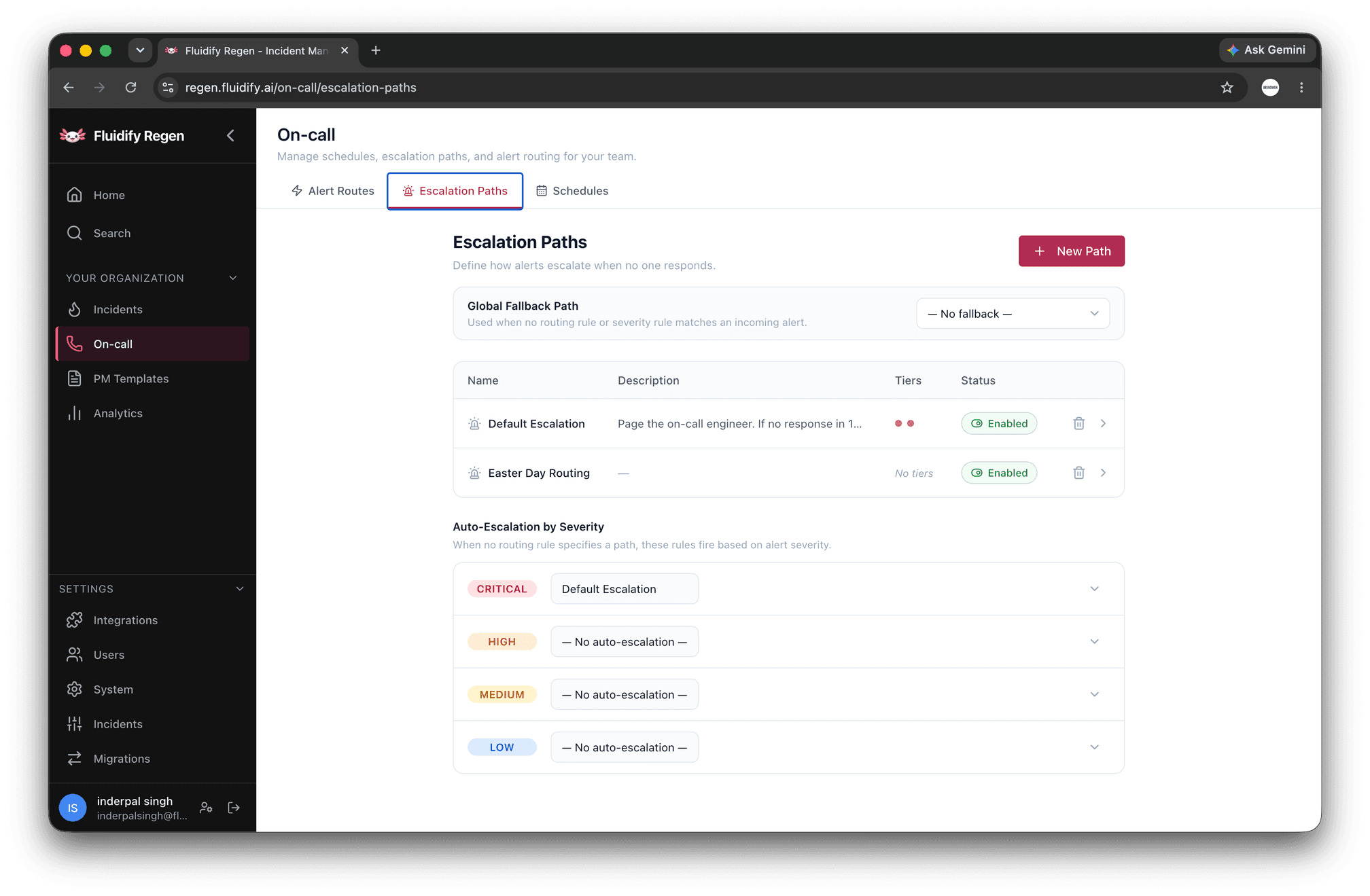
Regen covers the same core incident lifecycle mechanics from a different angle: an immutable timeline, escalation policies with multi-step timeouts, and alert ingestion from Prometheus Alertmanager, Grafana, AWS CloudWatch and generic webhooks, on top of Prometheus, Grafana, Datadog, Slack, Teams and 700+ other integrations. On-call schedules support rotations, overrides, holidays, exceptions and leave, with global timezone support on every tier.
Three tiers, plus a separate bill for on-call
FireHydrant's Free plan tops out at 10 responders, 2 runbooks, 1 public status page and 3 integrations. Pro moves to $25 per responder per month billed annually, with 5 runbooks, unlimited status pages and SSO, and alerting itself is a separate product: Signals is priced by how many alerts a team sends, not by responder count. Run the math on a 50-responder team at Pro list price: 50 times $25 times 12 months is $15,000 a year, before any Signals usage is added on top. That gap between list price and real spend shows up in Vendr's numbers too: the median tracked contract is $33,195 a year, well above the raw Pro rate. A full breakdown of the rest of the market is in our roundup of every FireHydrant alternative.
Regen's Pro plan is a flat $100 a month, about $1,200 a year, for that same 50-responder team, with on-call included from the start and no separate alerting product to license. The open-source tier runs the same way self-hosted, at $0.
AI retrospectives are an Enterprise feature, not a Pro one
FireHydrant's AI tooling looks genuinely useful on its own product page: AI-generated incident summaries, real-time call transcription from Zoom and Google Meet, and drafted retrospective answers built from everything the platform gathered during the incident. The catch is tier placement: summaries, transcripts, triage and retrospective drafting are Enterprise-only, the same tier as SCIM, audit logs and private incidents, and Enterprise has no published price. A Pro customer already paying per responder doesn't get any of it without a separate sales conversation.
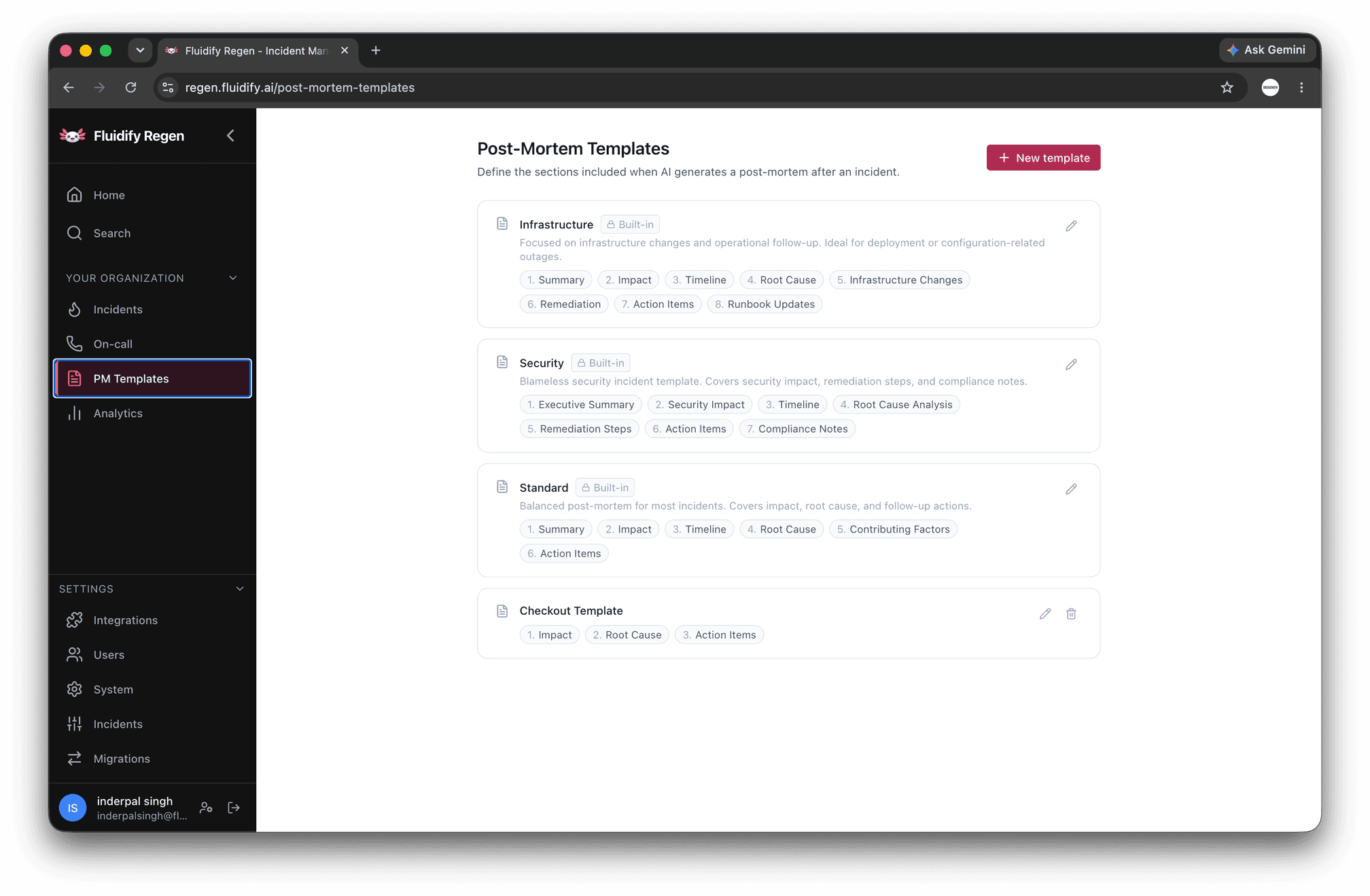
Regen's AI is built into the product at every tier, including the free self-hosted build: incident summaries, post-mortems and handoff digests generated automatically and synced back to Slack and Teams, plus pattern matching that learns from historical incidents. It runs on a model key brought by the customer, OpenAI, Anthropic or Ollama, and isn't billed by the action or reserved for a higher tier.
Deployment: AWS-hosted SaaS only, now under new ownership
FireHydrant has no self-hosted or on-premises deployment option at any tier. Its own subprocessors page lists Amazon Web Services and Google as the infrastructure providers behind the product, and the pricing page has no on-prem line at Free, Pro or Enterprise. For a team with data residency requirements, that's a fixed constraint, not a setting to change later.
That constraint got a new wrinkle in 2026. Freshworks announced a deal to acquire FireHydrant in December 2025, and the acquisition officially closed on January 5, 2026, folding FireHydrant into Freshservice's IT service management lineup. Whether that changes the roadmap for a standalone incident-management buyer is a question worth asking directly in a sales call, not assuming either way.
Regen ships open source and self-hosted by default across five deployment surfaces: self-hosted VPC, on-prem, private cloud, air-gapped and cloud SaaS, deployed via one Docker Compose file or a Kubernetes manifest in under five minutes. The Helm chart runs non-root (UID 1001), with a read-only root filesystem and every Linux capability dropped, none of it behind a paid tier, documented in the repo's SECURITY.md.
Notifications, chat and mobile
FireHydrant's Signals product routes alerts over SMS, WhatsApp, voice calls where supported, its mobile app, email and Slack, billed by total alert volume rather than a flat channel allowance.
Regen's Slack integration covers channels, bot commands and live timeline sync; Microsoft Teams gets Adaptive Cards and bot commands the same way. Beyond chat, Regen pages through Telegram and mobile push on Android and iOS over Firebase Cloud Messaging on every tier, including the free self-hosted build, with Twilio voice and SMS plus a dedicated Android/iOS on-call app on the SaaS and Enterprise tiers.
Security, compliance and published numbers
FireHydrant has held SOC 2 Type II compliance since September 2021 and supports SAML 2.0 and SCIM, though SCIM itself is gated to Enterprise. What isn't published anywhere on its site is a load-test methodology or failover benchmark: an uptime claim without the test behind it to check.
Regen publishes its own load-test and chaos-test numbers instead of a marketed SLA figure: webhook ingestion p99 under 10 ms, tested to a peak of 3,917 RPS with zero 5xx errors, an 11-second Patroni Postgres failover RTO and a 5-second Redis failover RTO, documented with the test scripts in RELIABILITY.md. Regen also covers SOC 2, GDPR, DPDPA and EU AI Act alignment plus HIPAA guidelines, with the Enterprise tier adding custom SSO/SCIM, redaction protocols, MFA, and audit logs and traces.
Sources
- FireHydrant pricing
- Vendr FireHydrant pricing data
- FireHydrant Signals
- FireHydrant subprocessors
- FireHydrant AI
- FireHydrant integrations
- FireHydrant security
- FireHydrant Signals notification preferences
- FireHydrant to be acquired by Freshworks
- Freshworks-FireHydrant acquisition close
- Regen SECURITY.md
- Regen RELIABILITY.md
- FluidifyAI pricing
- Top 5 FireHydrant alternatives for 2026
Evaluating Regen against FireHydrant?
We'll walk through the exact comparison with you - feature by feature.