
Better Stack vs Regen
Better Stack prices incident management in pieces rather than one number: a Responder license costs $29 a month on annual billing, $34 month to month, and covers on-call paging plus basic uptime and telemetry access. Advanced Slack and Microsoft Teams workflows are a separate $9-a-responder-a-month add-on, the AI SRE investigation agent is billed on top of that at $5 per million tokens, and a team that wants to actually keep meaningful volumes of logs and traces pays for a third line item, a telemetry bundle starting around $45 a month for the smallest tier. None of that stacks into one quote automatically, you add it up yourself.
Regen is FluidifyAI's self-hosted alternative to PagerDuty and incident.io. It's open source and free to self-host, or a flat $100 a month on the Pro plan, with no per-responder pricing and no separate meters for AI, workflows or chat integrations. This is a comparison of Regen specifically, not the rest of the FluidifyAI suite.
What's actually included
Better Stack's genuine strength is that it isn't only an on-call tool: uptime checks (HTTP, TCP, DNS, SSL and domain expiry, and Playwright-driven browser transactions from a real Chrome instance), log management with SQL and PromQL query builders, distributed tracing, and status pages all live in the same product. A downtime alert, a stack trace and the log line that caused it show up in one console instead of three separate logins. When something goes down, it automatically captures a screenshot, a second-by-second timeline, and a traceroute and MTR trace, according to its own uptime product page. That's a real advantage for a team that wants one vendor for observability and paging.
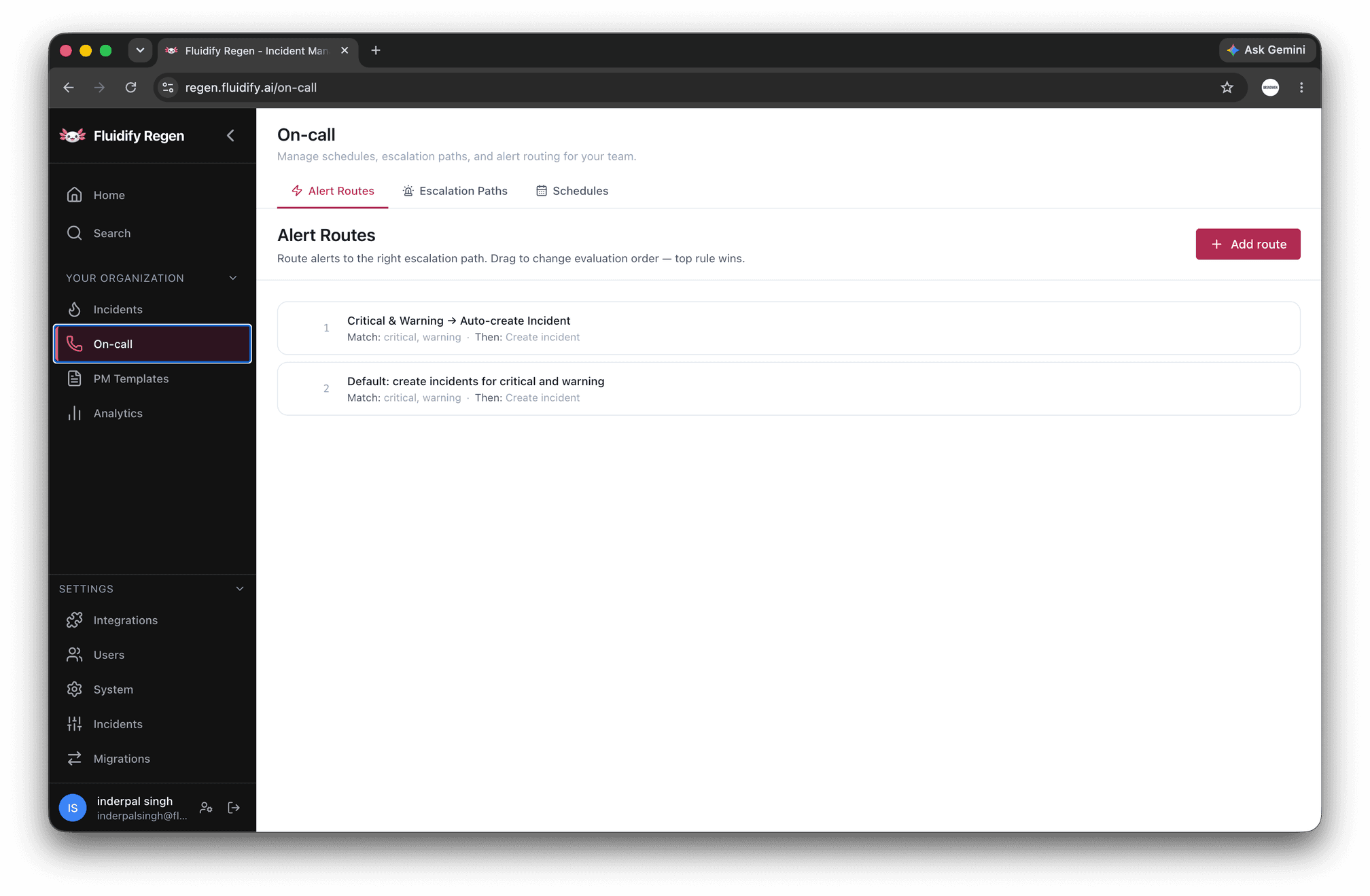
Regen doesn't compete with that half of the product, and it's honest about that: it has no uptime checks, no log storage and no tracing of its own, it ingests alerts from Prometheus Alertmanager, Grafana, AWS CloudWatch and generic webhooks rather than generating its own telemetry, on top of Prometheus, Grafana, Datadog, Slack, Teams and 700+ other integrations. What it covers well is the on-call half: an incident lifecycle with an immutable timeline, escalation policies with multi-step timeouts, and schedules with rotations, overrides, holidays, exceptions and leave, with global timezone support on every tier and multi-lingual interfaces on the SaaS and Enterprise tiers.
Pricing and limits
Run the math on a 50-responder team, annual billing: 50 at $29 is $1,450 a month for on-call access alone. Add the advanced Slack and Teams workflow add-on at $9 a responder and that's another $450 a month, plus $250 flat a month for audit logs, and the on-call and workflow portion alone runs about $2,150 a month, roughly $25,800 a year. That figure still doesn't include telemetry: a team that wants to actually keep and query its logs and traces pays for a separate telemetry bundle on top, starting at $45 a month for the smallest tier and running past $750 a month for the largest tier Better Stack lists, depending on data volume.
Regen's Pro plan is a flat $100 a month for that same 50-person team, about $1,200 a year, with no per-responder multiplier, no separate workflow add-on, and no telemetry meter to budget for, because Regen isn't billing for stored log volume in the first place. The open source tier runs the same way self-hosted, at $0.
Deployment: self-hosted vs. SaaS-only
Better Stack is a hosted product. Its own enterprise page offers self-serve clusters in four regions (Virginia, Oregon, Germany, Singapore) and, on request, a custom cluster with a dedicated S3 bucket in the customer's own VPC for enterprise accounts, but that's data residency for Better Stack's own hosted service, not a self-hosted deployment of the platform itself. There's no Docker Compose file or Helm chart that lets a team run Better Stack on its own infrastructure, at any price.
Regen ships across five deployment surfaces: self-hosted VPC, on-prem, private cloud, air-gapped, or cloud SaaS, the same product either way, deployable in under five minutes with a single Docker Compose file or Kubernetes. The Helm chart runs non-root (UID 1001), with a read-only root filesystem and every Linux capability dropped, none of it behind a paid tier, documented in SECURITY.md. Regen also publishes its own load-test and chaos-test numbers instead of a marketed SLA: webhook ingestion p99 under 10 ms, tested to a peak of 3,917 RPS with zero 5xx errors, an 11-second Patroni Postgres failover RTO and a 5-second Redis failover RTO, documented with the test scripts in RELIABILITY.md. Better Stack states it is SOC 2 Type 2 compliant and GDPR compliant, but explicitly not HIPAA compliant as of this writing; Regen follows SOC 2, GDPR, DPDPA, EU AI Act and HIPAA guidelines, with the Enterprise tier adding custom SSO/SCIM, redaction protocols, MFA, and audit logs and traces.
AI and automation
Better Stack's AI SRE agent is triggered manually. According to its own documentation, you open an incident and click "Investigate with AI SRE," and it pulls the incident timeline, on-call users, comments and linked issues, then queries logs and metrics to suggest a root cause. It can produce a document with an evidence timeline and log citations, and Better Stack says it never takes automated actions without approval. It's billed separately from the Responder license and telemetry bundles, at $5 per million tokens, so a month of heavy incident investigation adds its own line to the bill rather than being covered by the subscription.
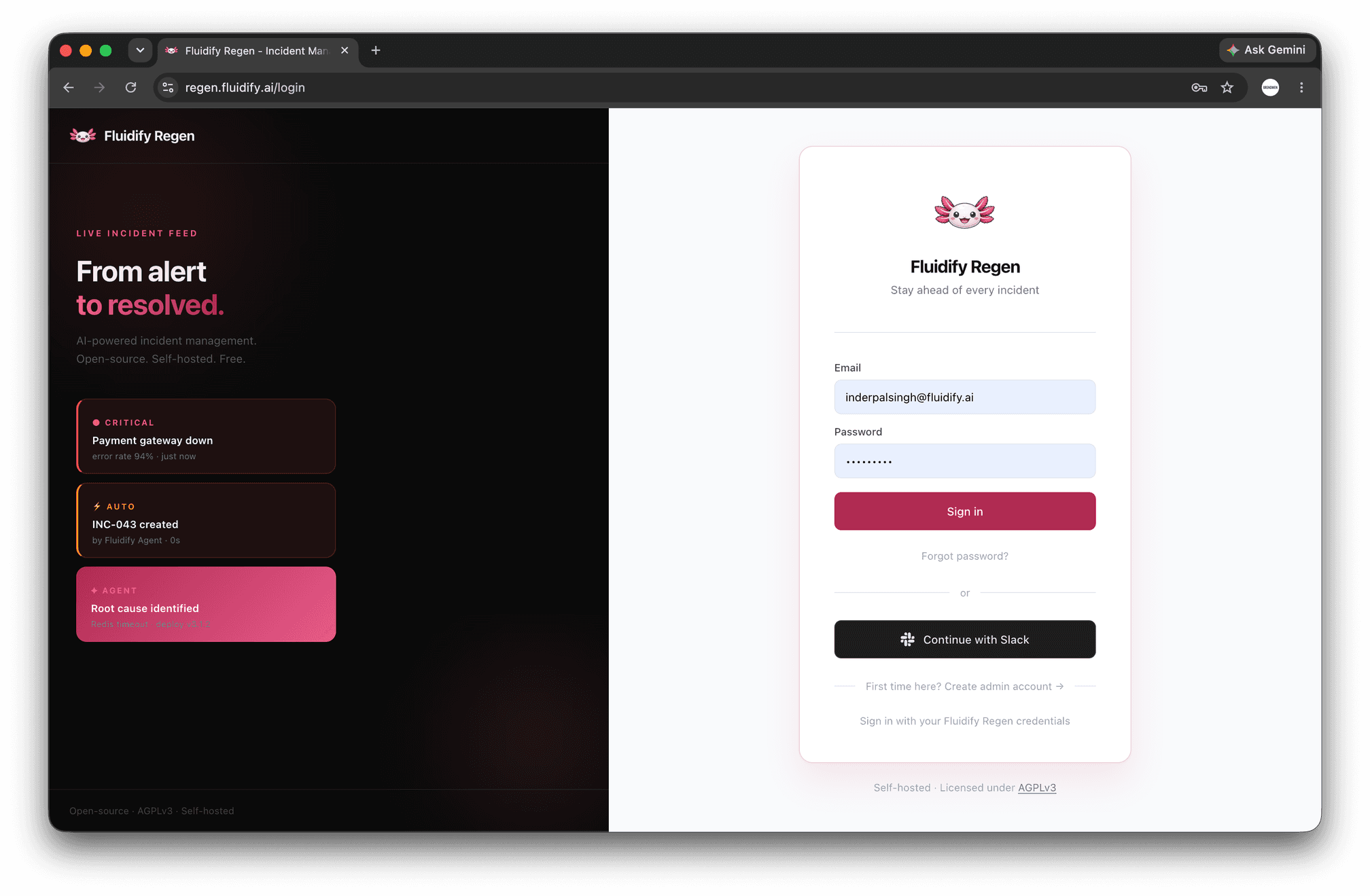
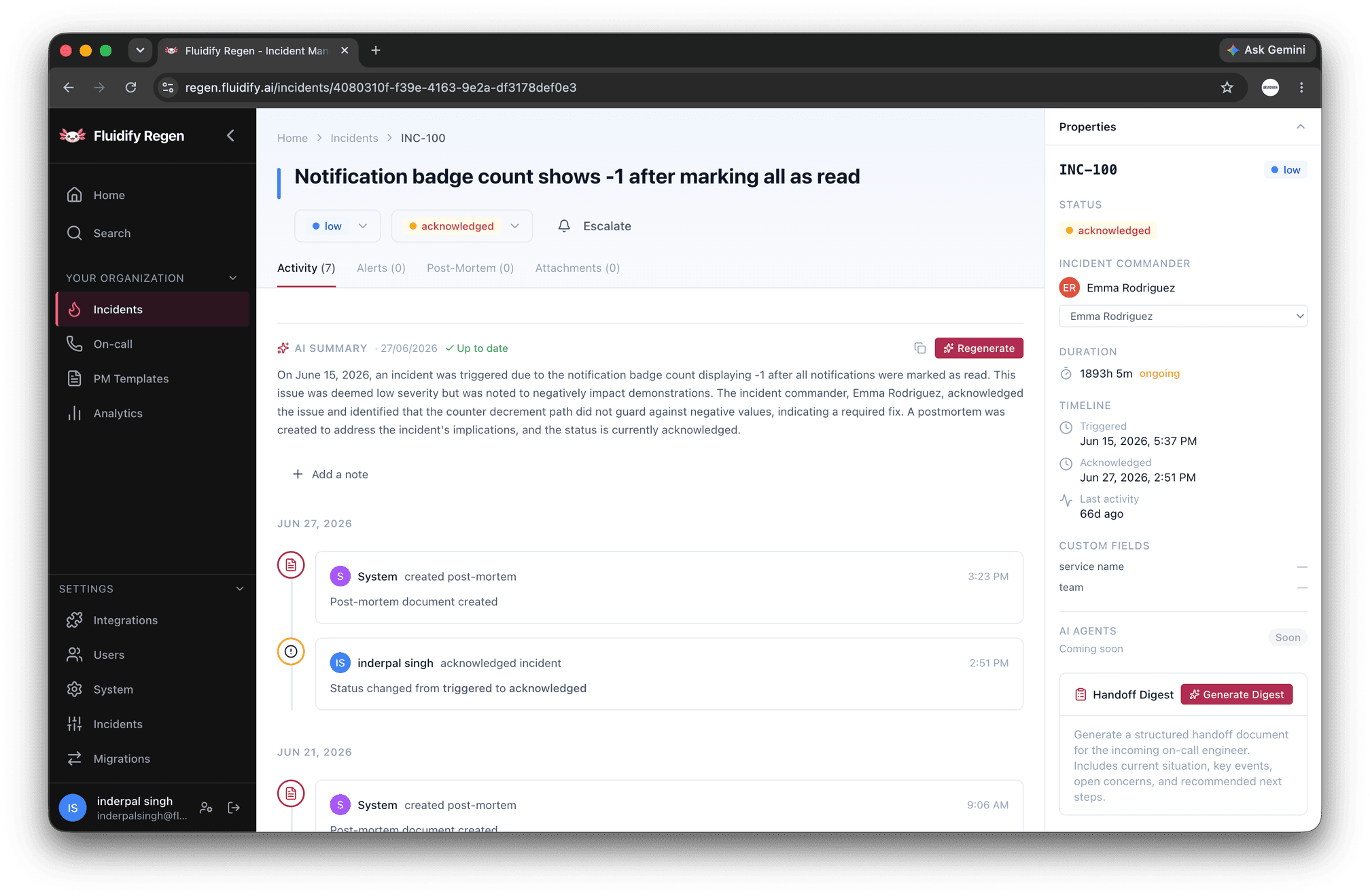
Regen's AI runs the other way: incident summaries, postmortems and handoff digests generate automatically on every incident, no button to click, and sync back to Slack and Teams without a person assembling the document, on top of pattern matching that learns from historical incidents. It runs on a model key you bring yourself, OpenAI, Anthropic or Ollama, and is included on every tier rather than billed by the token.
Notifications, chat and mobile
Better Stack pages through Slack, Microsoft Teams, email, SMS and phone calls, plus dedicated iOS and Android on-call apps with critical alerts that can bypass silent mode, and phone call alerts documented separately for both platforms. Basic Slack integration is included with a Responder license; the channel-based and thread-based workflow version is the $9-a-responder add-on covered above.
Regen's Slack integration covers channels, bot commands and live timeline sync at every tier; Microsoft Teams gets Adaptive Cards and bot commands the same way. Beyond chat, Regen pages through Telegram on every tier including the open-source edition, mobile push notifications on Android and iOS over Firebase Cloud Messaging on every tier including open source, and Twilio for voice and SMS plus a dedicated Android/iOS on-call app on the SaaS and Enterprise tiers.
SSO, integrations and what's honestly comparable
Better Stack includes SSO with Google on its paid Responder tier, but Azure and Okta SSO cost an extra $5 a user a month, and generic SAML SSO is listed as an enterprise-only feature. Its own integrations page lists around 60 tools across log sources, cloud monitoring, scheduling and messaging.
Regen ships SSO and SAML 2.0 for Okta, Azure AD, Google Workspace and any compliant identity provider, included free on every tier, across 700+ integrations including Prometheus, Grafana, Datadog, Slack and Teams. Better Stack isn't on Regen's list of named 1-click migration importers (Grafana OnCall, Opsgenie and PagerDuty carry schedules and escalation policies over automatically); moving off Better Stack today means rebuilding on-call rotations and escalation policies by hand rather than an automated import.
Sources
- Better Stack pricing
- Better Stack AI SRE welcome docs
- Better Stack AI SRE incident analysis docs
- Better Stack security and compliance page
- Better Stack enterprise page
- Better Stack integrations page
- Better Stack uptime product page
- Better Stack logs product page
- Better Stack mobile app docs
- Better Stack phone call alert docs
- Regen SECURITY.md
- Regen RELIABILITY.md
- FluidifyAI pricing
- FluidifyAI integrations
Evaluating Regen against Better Stack?
We'll walk through the exact comparison with you - feature by feature.