
Rootly vs Regen
Rootly's own pricing page sells Incident Response and On-Call as two separate products, each starting at $20 a user monthly at the Essentials tier, with a third product, AI SRE, priced only through a sales call. Rootly does discount when a customer buys all three together, but the list price is still per seat, per product: a 50-person team buying just Incident Response and On-Call at Essentials pricing is looking at about $24,000 a year before AI SRE or the Enterprise tier enter the conversation. Vendr's aggregated buyer data puts mid-market Rootly deals (50 to 150 seats) at $35,000 to $60,000 a year on the Scale tier, and 150-plus seat enterprise deals at $60,000 to $100,000-plus.
Regen is FluidifyAI's self-hosted alternative to Rootly, PagerDuty, and incident.io. It's open source and free to self-host, or a flat $100 a month on the Pro plan, with no per-user pricing and one product instead of three to buy. This is a comparison of Regen specifically, not the rest of the FluidifyAI suite.
What's actually included
Rootly's real strength is breadth: on-call, incident response, retrospectives, status pages, and an AI SRE layer, all built around deep Slack and Microsoft Teams-native workflows. Rootly lists 100-plus integrations spanning monitoring, ticketing, and communication tools, and holds SOC 2 Type II certification alongside ISO 27001 and GDPR compliance. In July 2026 it acquired ThinkHive, an AI agent reliability platform, pushing its AI SRE ambitions beyond traditional incident response and into evaluating the LLM-based agents customers now run in production.
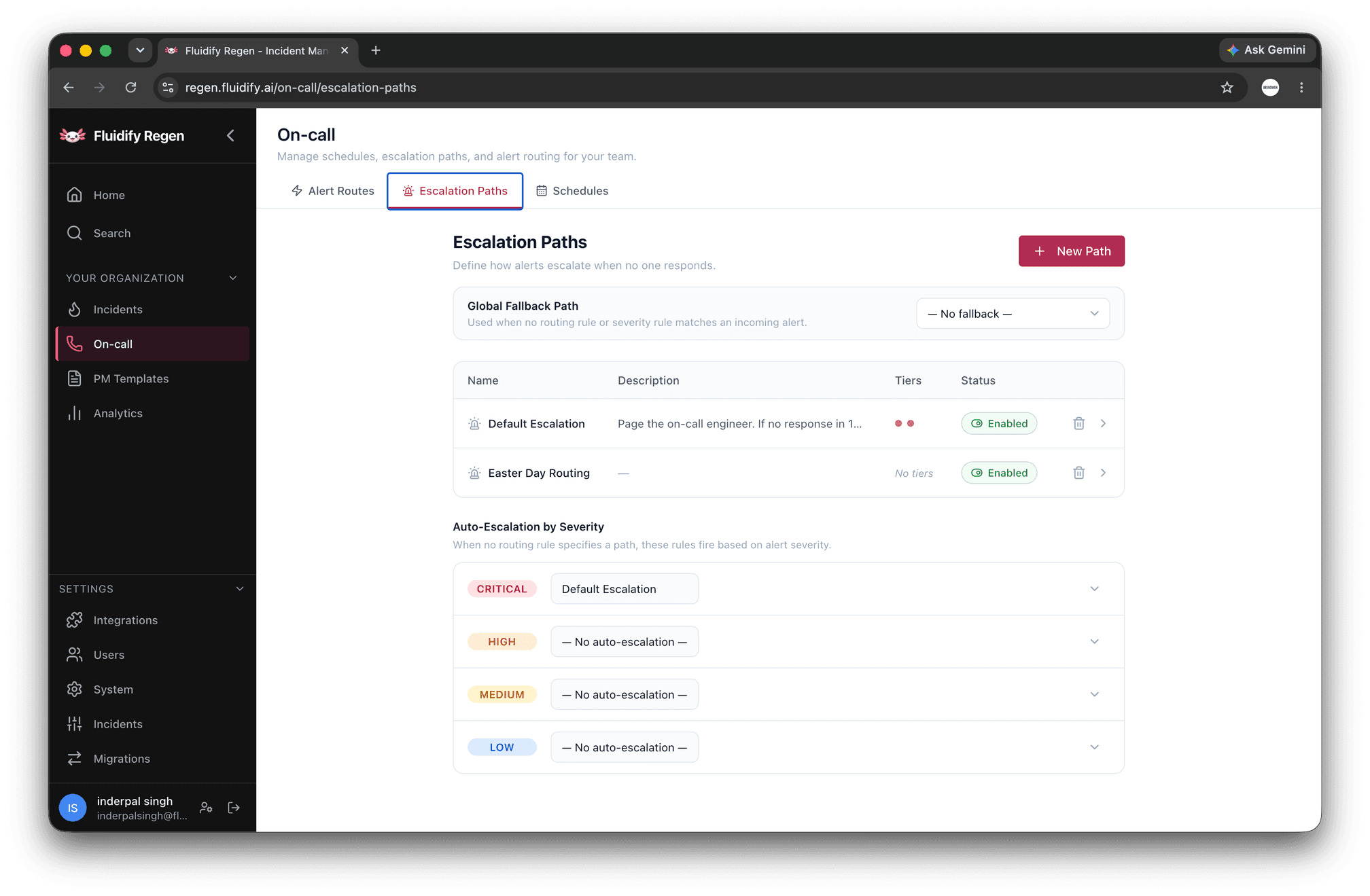
Regen covers the same core on-call and incident mechanics on its own: an incident lifecycle with an immutable timeline, escalation policies with multi-step timeouts, and alert ingestion from Prometheus Alertmanager, Grafana, AWS CloudWatch, and generic webhooks, on top of Prometheus, Grafana, Datadog, Slack, Teams, and 700+ other integrations. On-call schedules support rotations, overrides, holidays, exceptions, and leave, with global timezone support on every tier.
Two products, priced per seat, plus a third
A 20-person team buying just Incident Response and On-Call at Rootly's published Essentials list price pays about $9,600 a year ($20 x 2 products x 20 users x 12 months); the same math at 50 people runs about $24,000 a year, and that's before AI SRE, which Rootly prices only through a sales call, or the Enterprise tier, which drops the published number entirely. Rootly does offer up to a 50% startup discount for companies under 100 employees, under $50 million raised, and under 5 years old, which is worth crediting directly if a team qualifies.
Regen's Pro plan is a flat $100 a month regardless of team size, about $1,200 a year. Business, which adds Reflex and Gills from the broader FluidifyAI suite, is a flat $200 a month, about $2,400 a year. Neither has a per-seat multiplier, and on-call and incident response are one product, not two separate line items to negotiate.
AI SRE and AI post-mortems: who pays, and how
Rootly's lighter AI features, in-app AI chat, a meeting-note "AI Scribe," and similar-incident detection, ship inside the $20-a-user Essentials seat. The deeper AI SRE product, root cause identification, alert correlation with recent changes, impact analysis, and remediation suggestions, is priced separately and disclosed only on a call with sales. It follows the same per-seat logic as the rest of the platform: more responders on AI SRE means more seats, means a larger bill. It isn't metered by incident or by token, but it also isn't free, and the price isn't published.
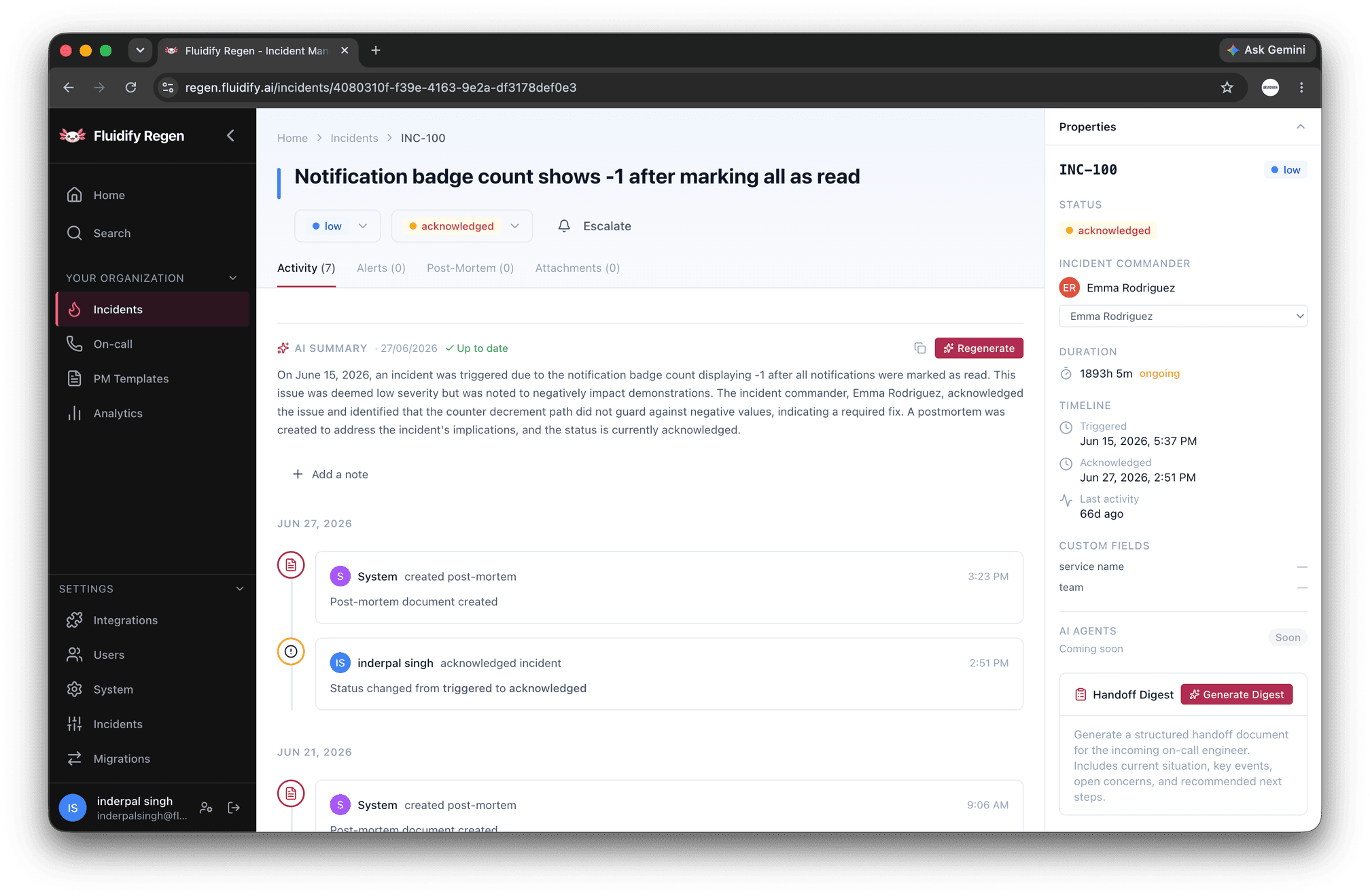
Regen's AI, incident summaries, post-mortems, and handoff digests, runs on a model key the customer brings, OpenAI, Anthropic, or Ollama, and is included free on every tier, including the open-source self-hosted edition. There's no seat count or sales call between turning it on and using it.
Self-hosted by default, not bridged from the cloud
Rootly's core platform is cloud-only, and stays that way even for enterprise customers. It does ship a self-hostable Edge Connector, a lightweight Go binary that polls Rootly's API over HTTPS and runs local scripts or webhooks, so Rootly can reach internal, firewalled systems without opening an inbound port. That's real engineering, but it's a bridge, not a deployment option: the incident record, schedules, and workflow logic all still live in Rootly's cloud, not on infrastructure the customer controls.
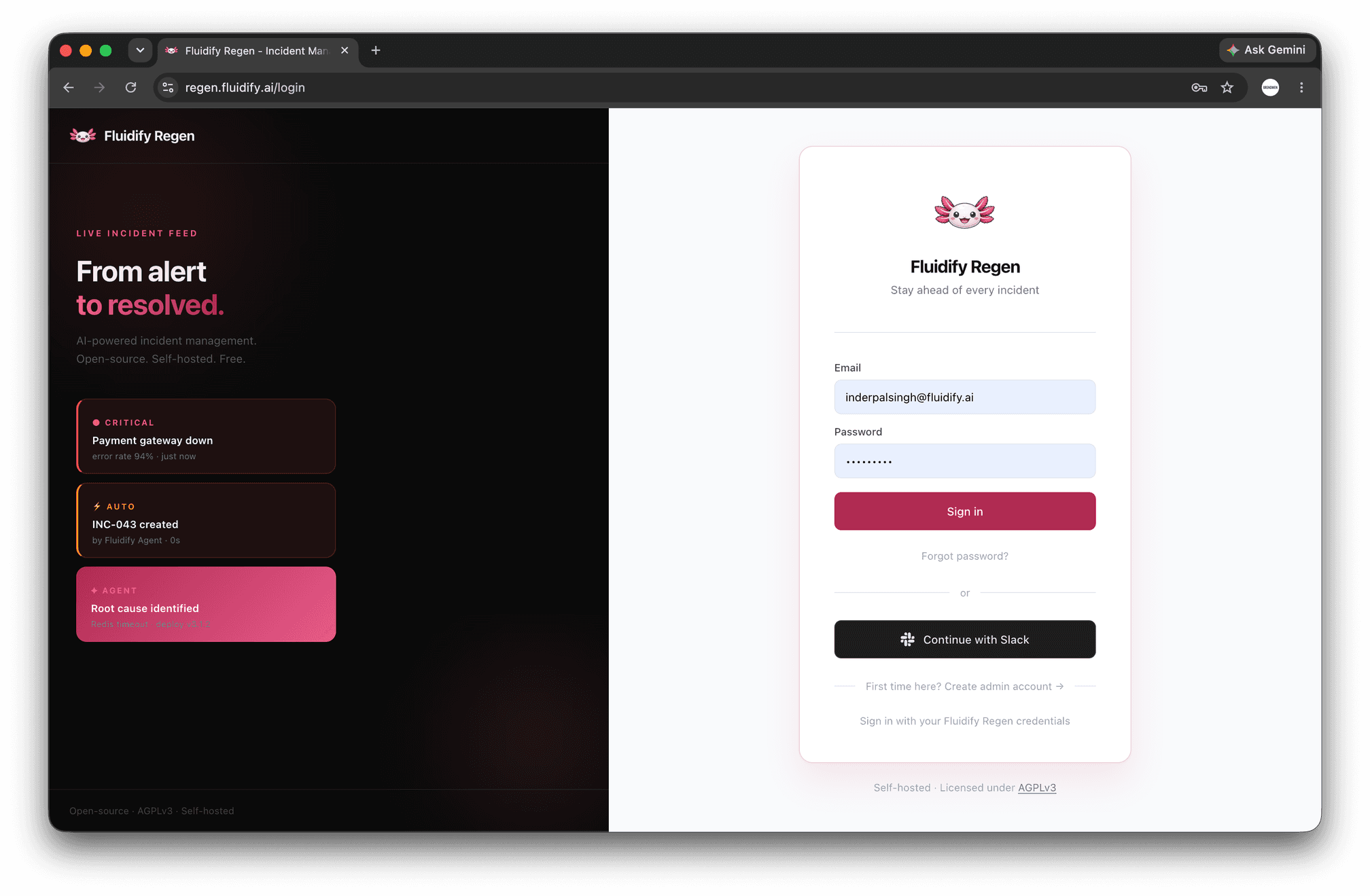
Regen ships open source and self-hosted by default, across five deployment surfaces: self-hosted VPC, on-prem, private cloud, air-gapped, or Regen's own cloud SaaS. A single Docker Compose file or Kubernetes manifest gets it running in under five minutes. The Helm chart runs non-root (UID 1001), with a read-only root filesystem and every Linux capability dropped, documented in the repo's SECURITY.md, none of it gated behind a paid tier.
Security, compliance, and reliability
Rootly holds SOC 2 Type II certification, plus ISO 27001 and GDPR compliance, solid coverage for a cloud incident platform. What it doesn't publish is load-test or failover data: no public numbers for ingestion latency, throughput under load, or database failover time.
Regen publishes its own reproducible load-test and chaos-test numbers instead of a marketed SLA: webhook ingestion p99 under 10 ms, tested to a peak of 3,917 RPS with zero 5xx errors, an 11-second Patroni Postgres failover RTO, and a 5-second Redis failover RTO, documented with the test scripts in RELIABILITY.md. It also carries SOC 2, GDPR, DPDPA, and EU AI Act coverage, plus HIPAA guidelines, with the Enterprise tier adding custom SSO/SCIM, redaction protocols, MFA, and audit logs and traces.
Notifications, mobile, and what's gated by tier
Rootly pages through Slack and a native Microsoft Teams integration with automatic channel creation and slash commands, plus a mobile app included at the Essentials tier. Voice paging is metered by phone number: Essentials includes one live-call-routing number, Enterprise adds up to five, and support for China is an Enterprise-only add-on on the On-Call product.
Regen pages through Slack, Microsoft Teams, Telegram, and mobile push over Firebase Cloud Messaging on every tier, including the free open-source edition. Twilio voice and SMS, and a dedicated iOS/Android on-call app, ship on the SaaS and Enterprise tiers, and multi-language interface support ships on those same tiers rather than being split by phone-number count.
Sources
- Rootly pricing
- Vendr Rootly pricing data
- Rootly engineering page
- Rootly SOC 2 Type II announcement
- Rootly acquires ThinkHive (Businesswire)
- Rootly Edge Connector changelog
- Rootly Microsoft Teams integration
- Regen SECURITY.md
- Regen RELIABILITY.md
- FluidifyAI pricing
- FluidifyAI integrations
- FluidifyAI Regen product page
Evaluating Regen against Rootly?
We'll walk through the exact comparison with you - feature by feature.