
xMatters vs Regen
xMatters has been owned by Everbridge since the deal closed on May 7, 2021, for about $240 million in cash and stock, and it now ships as "Everbridge xMatters," a workflow-orchestration layer inside a much larger critical-event-management portfolio rather than a standalone on-call product. Its own pricing page currently lists a free tier capped at 5 users, not the 10 that some third-party trackers still quote, then two published per-seat tiers, Starter at $15 a user a month and Base at $39 a user a month, with a fourth Advanced tier priced only through a sales call. Published per-seat figures disagree across sources, so this comparison uses xmatters.com's own pricing page, checked directly, as the source of truth rather than repeating a secondary summary.
Regen is FluidifyAI's self-hosted alternative to PagerDuty and incident.io. It's open source and free to self-host, or a flat $100 a month on the Pro plan, with no per-seat pricing and no acquiring parent company's roadmap to compete with. This is a comparison of Regen specifically, not the rest of the FluidifyAI suite.
What's actually included
xMatters' real strength is workflow orchestration for large, complex organizations. Flow Designer, its no-code visual workflow builder, lets teams chain xMatters into ServiceNow, Jira and other ITSM tools without writing integration code, and in March 2026 Everbridge xMatters ranked No. 1 on G2's Top 20 IT Alerting Software list, scoring 9.3 on ease of use and 9.4 on quality of support. Every published tier, including the free one, ships with 200+ pre-packaged integrations and no published cap on how many you connect.
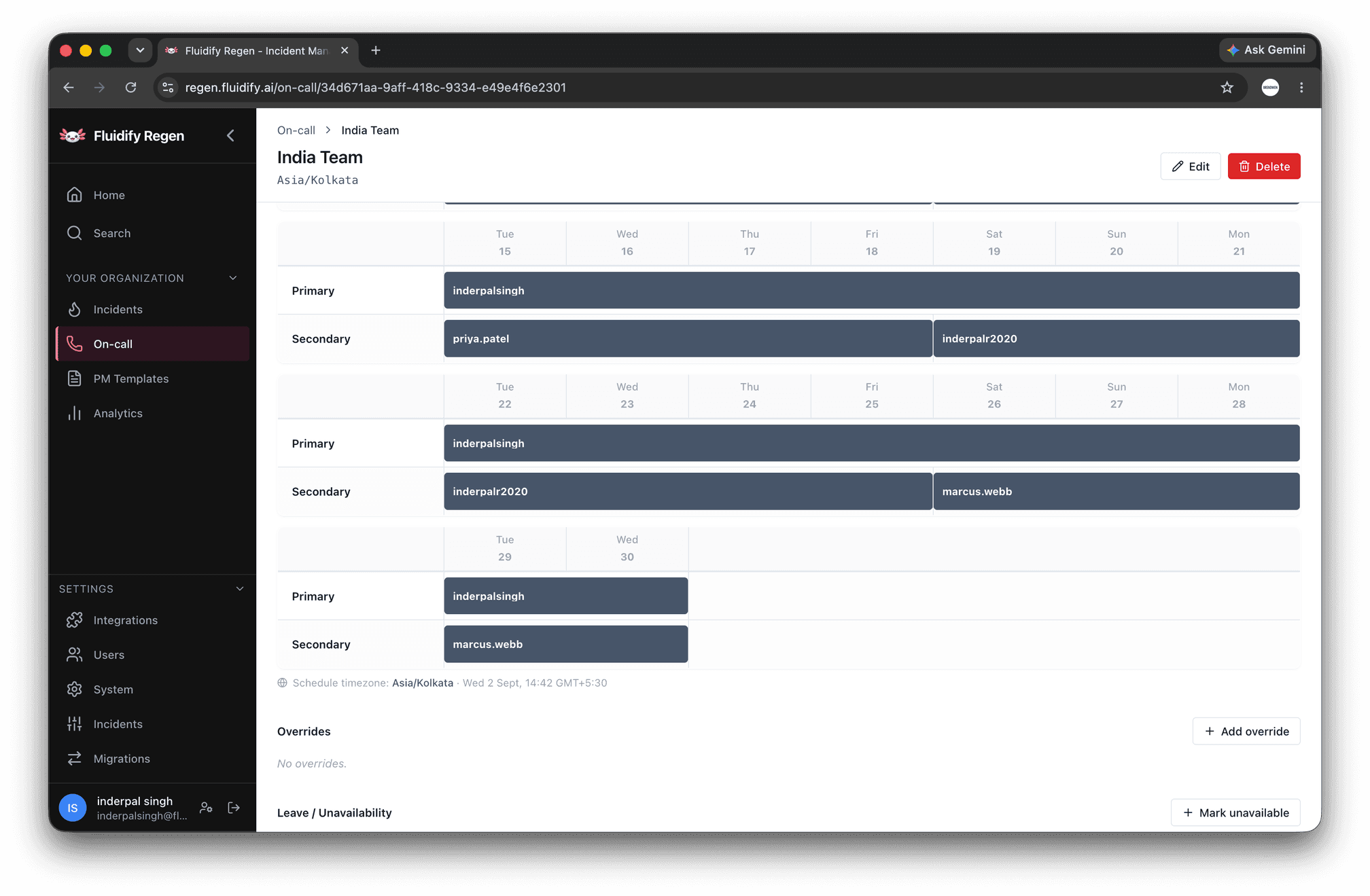
Regen covers the same core on-call mechanics on its own: an incident lifecycle with an immutable timeline, escalation policies with multi-step timeouts, and alert ingestion from Prometheus Alertmanager, Grafana, AWS CloudWatch and generic webhooks, on top of Prometheus, Grafana, Datadog, Slack, Teams and 700+ other integrations. On-call schedules support rotations, overrides, holidays, exceptions and leave, with global timezone support on every tier and a multi-lingual interface on the SaaS and Enterprise tiers.
Pricing and ownership
Past the free tier, xMatters charges per seat, and the published numbers move depending on where you look. xmatters.com's own pricing page currently shows Starter at $15 a user a month, capped at 25 users, and Base at $39 a user a month with no published seat cap; several third-party trackers instead list a Starter price closer to $9 a user a month and a free tier of 10 users rather than 5. We couldn't reconcile those lower numbers against anything currently on xmatters.com, so treat any per-seat figure that doesn't match the vendor's own page with some caution. Run the math on the Base tier for a 50-person team: 50 seats at $39 a month is $1,950 a month, about $23,400 a year, before any SMS or voice usage past the plan's monthly per-user allotment.
Regen's Pro plan is a flat $100 a month for that same 50-person team, about $1,200 a year, with no per-seat multiplier and no cap on users, incidents, schedules or AI usage. xMatters' roadmap also now answers to Everbridge's broader critical-event-management strategy rather than a dedicated on-call product team, following the $240 million acquisition that closed in May 2021.
Deployment and reliability
xMatters has no self-hosted option for its core platform. The closest it offers is an Integration Agent that installs on-premises purely to bridge internal systems into the hosted xMatters cloud instance, not a way to run xMatters itself inside your own infrastructure. Regen ships open source and self-hosted by default, across five deployment surfaces: self-hosted VPC, on-prem, private cloud, air-gapped or cloud SaaS. The Helm chart runs non-root (UID 1001), with a read-only root filesystem and every Linux capability dropped, none of it behind a paid tier, documented in the repo's SECURITY.md.
Regen also publishes its own load-test and chaos-test numbers rather than a marketed SLA figure: webhook ingestion p99 under 10 ms, tested to a peak of 3,917 RPS with zero 5xx errors, an 11-second Patroni Postgres failover RTO and a 5-second Redis failover RTO, documented with the test scripts in RELIABILITY.md. xMatters publishes an uptime SLA of 99.90% on its Starter and Base tiers, but not a load-test methodology behind that number, so there's nothing to compare Regen's reproducible figures against directly.
AI and automation
Everbridge introduced an AI Agent inside xMatters in November 2025, generating incident summaries, recommending runbooks and resolvers from past incidents, and drafting executive communications during an active incident. On xMatters' own pricing page, that Incident AI Agent is listed only on the top Advanced tier, the custom-quote plan above Base; Free, Starter and Base get narrower AIOps features like noise reduction and alert correlation, but not the full agent.
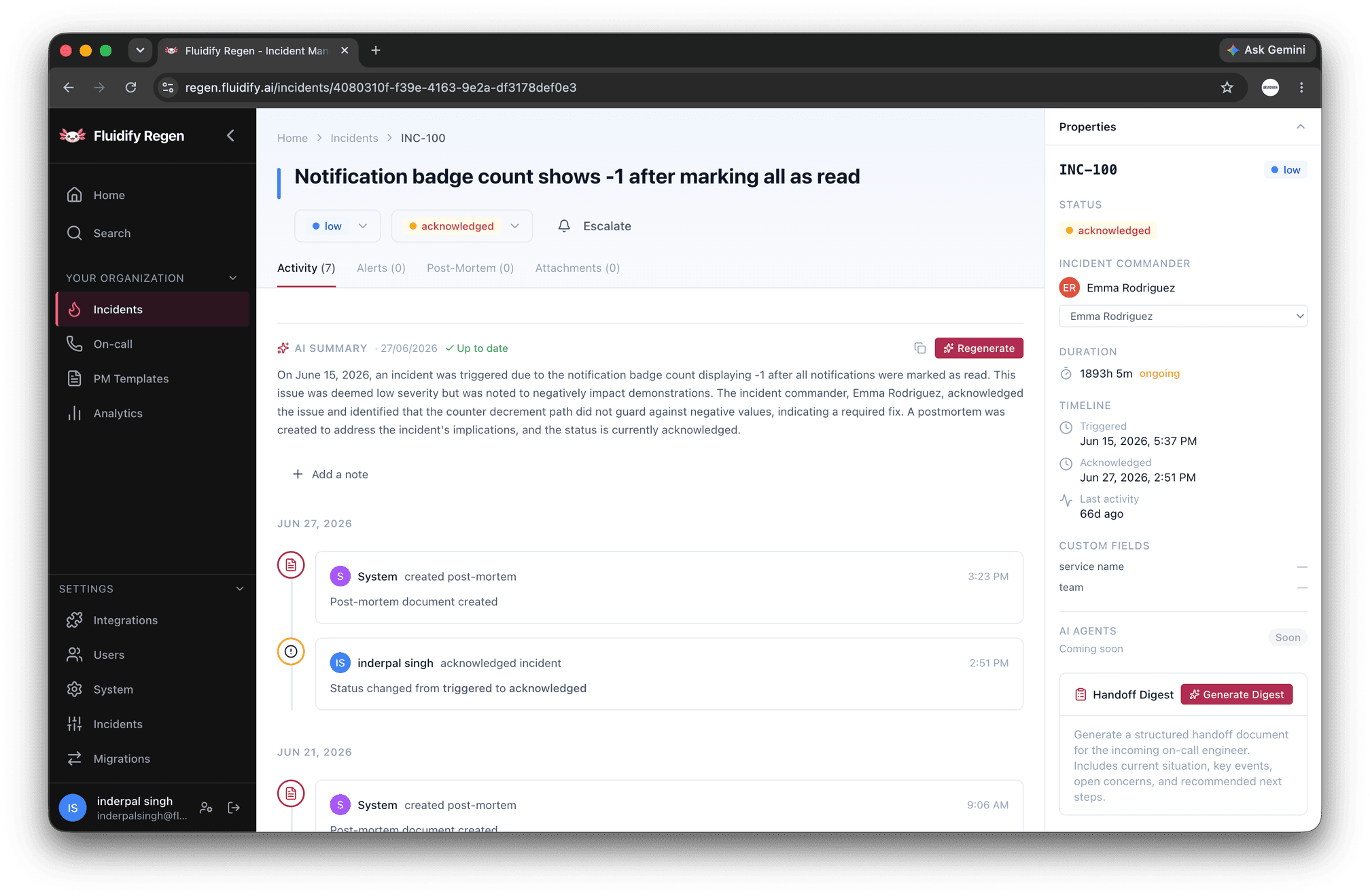
Regen's AI is built into the product at every tier, including the free self-hosted one: incident summaries, post-mortems and handoff digests generated automatically and synced back to Slack and Teams, plus pattern matching that learns from historical incidents. It runs on a model key you bring yourself, OpenAI, Anthropic or Ollama, and isn't gated to a specific plan or billed by the action.
Notifications, SSO and mobile
xMatters' Free tier includes unlimited push and email notifications but excludes SMS and voice entirely; Starter adds 50 SMS messages and 10 voice minutes per user a month, and Base doubles that to 100 SMS and 20 voice. SSO follows the same pattern: it's withheld from the Free tier and only becomes available on Starter and above, and multi-language messaging is Base tier and above only.
Regen doesn't gate notification channels or identity behind a tier. Slack (channels, bot commands, timeline sync), Microsoft Teams (Adaptive Cards, bot commands), Telegram and mobile push over Firebase Cloud Messaging are all included on the free self-hosted tier. Twilio voice and SMS and a dedicated iOS/Android on-call app are SaaS and Enterprise features. SSO and SAML 2.0, for Okta, Azure AD, Google Workspace or any compliant identity provider, ships free on every tier including self-hosted.
Migration
xMatters isn't one of the platforms Regen has a dedicated one-click importer for today; that list currently covers Grafana OnCall, Opsgenie and PagerDuty. Moving schedules and escalation policies off xMatters means exporting them by hand or working with FluidifyAI's team directly, not a self-serve button, and that's worth stating plainly rather than promising an importer that doesn't exist yet. xMatters' Flow Designer chains also tend to be organization-specific and built up over years, which is the kind of configuration that resists automated migration tooling from any vendor, not just Regen's.
Sources
Evaluating Regen against xMatters?
We'll walk through the exact comparison with you - feature by feature.