
incident.io vs Regen
incident.io still charges in two layers: a base seat price plus a separate on-call add-on. Team runs $15 a user a month on annual billing ($19 monthly) for the base plan, plus $10 a user for on-call; Pro runs $25 a user base, plus $20 a user for on-call, for $45 a user all in. The AI-native post-mortem drafting incident.io shipped on March 17, 2026, which pulls a full draft from a Slack thread, the incident timeline and linked pull requests in seconds, only ships on the Pro and Enterprise plans, so a team still on Team doesn't get it even after paying for on-call.
Regen is FluidifyAI's self-hosted alternative to PagerDuty and incident.io. It's open source and free to self-host, or a flat $100 a month on the Pro plan, with no per-user pricing, no separate on-call add-on and no AI tier to pay for separately. This is a comparison of Regen specifically, not the rest of the FluidifyAI suite.
What's actually included
incident.io's genuine strength is a workflow built around Slack and Teams from the ground up. Typing /incident or /inc in any channel opens a declaration form for a live, retrospective or test incident, and the incident resolves without anyone leaving chat. On-call schedules support layered rotations, calendar overrides and if-else escalation paths that route by priority and time of day, and the company backing it just raised a $62 million Series B led by Insight Partners in April 2025, earmarked specifically for AI incident response.
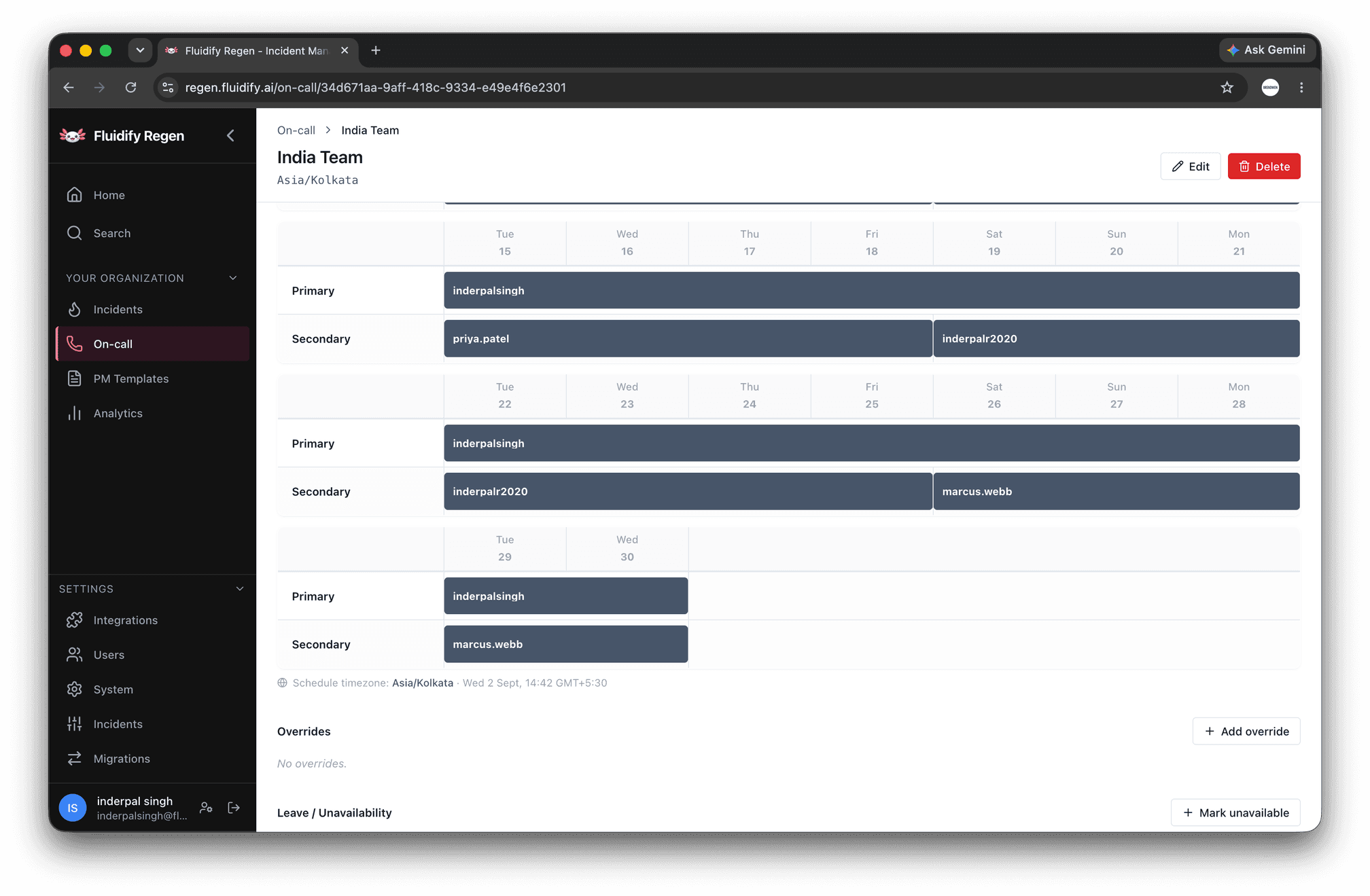
Regen covers the same core mechanics: an incident lifecycle with an immutable timeline, escalation policies with multi-step timeouts, and alert ingestion from Prometheus Alertmanager, Grafana, AWS CloudWatch and generic webhooks, on top of Prometheus, Grafana, Datadog, Slack, Teams and 700+ other integrations. On-call schedules support rotations, overrides, holidays, exceptions and leave, with global timezone support on every tier and a multi-lingual interface on the SaaS and Enterprise tiers.
Pricing and the on-call add-on stack
incident.io's Team plan is $15 a user a month annual ($19 monthly) for the base plan, plus $10 a user for on-call, for $25 a user all in. Pro is $25 a user base plus $20 a user for on-call, for $45 a user all in. A 50-person team where everyone carries a pager, on Pro, runs about $2,250 a month, roughly $27,000 a year, before Enterprise's custom pricing for SCIM, unlimited status pages and a 99.99% uptime SLA even enters the conversation. The free Basic tier caps out at 2 integrations and 1 on-call schedule, which rules it out for most real teams quickly.
Regen's Pro plan is a flat $100 a month for that same 50-person team, about $1,200 a year, with on-call, incident response and AI folded into the same price instead of three separate line items. The open-source tier runs the same way self-hosted, at $0. FluidifyAI estimates the gap works out to about $50,000 a year in savings for Regen alone against a typical 100-engineer team's usual per-seat spend.
AI post-mortems: real, but gated behind Pro
Credit where it's due: incident.io's March 17, 2026 post-mortem overhaul is a real, shipped product, not a roadmap slide. It pulls a Slack or Teams thread, the incident timeline, linked pull requests and custom fields into a complete draft post-mortem in seconds, and Scribe, its AI meeting notetaker, sits in on the retro and writes it up. That's a genuinely useful workflow, and it's newer than the version of incident.io most comparison pages still describe.
It's also gated twice. By incident.io's own account, all of our AI features and multiple documents are only available on Pro and Enterprise plans, so a Team-plan customer already paying for the on-call add-on doesn't get any of it without upgrading again to a $45-a-user tier. Even there, AI drafting only activates once an organization opts in to sending private incident data to incident.io's AI subprocessors in its AI settings, an org-wide decision, not a per-user toggle.
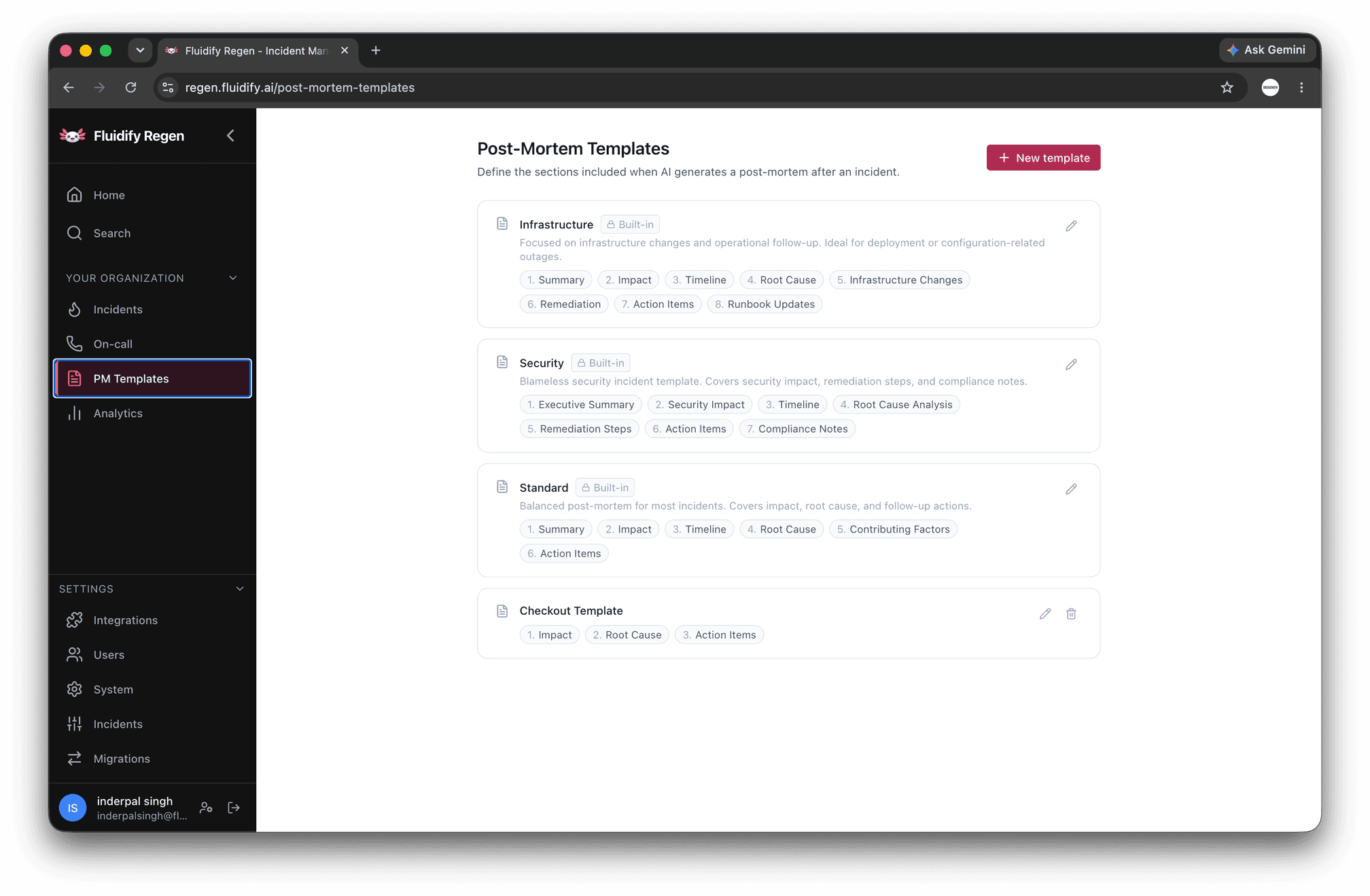
Regen's AI, incident summaries, post-mortems and handoff digests, is generated automatically and synced back to Slack and Teams on every tier, including the free self-hosted one, running on a model key the team brings itself: OpenAI, Anthropic or Ollama. It isn't a Pro-tier feature and isn't billed by the seat or the action.
Deployment, security and compliance
incident.io runs as a single multi-tenant cloud service: its own security FAQ describes the primary web application, Slack integration and related components as deployed onto Google Cloud Platform, with no self-hosted, on-premise or single-tenant option mentioned anywhere in it. It carries SOC 2 Type I and II and GDPR compliance, which is a real bar cleared. Regen ships open source and self-hosted by default across five surfaces, self-hosted VPC, on-prem, private cloud, air-gapped and cloud SaaS, with the Helm chart running non-root (UID 1001), a read-only root filesystem and every Linux capability dropped, none of it behind a paid tier, documented in the repo's SECURITY.md. Regen also carries SOC 2, GDPR, DPDPA, EU AI Act and HIPAA guideline coverage, with Enterprise adding custom SSO/SCIM, redaction protocols, MFA and audit logs and traces.
SSO is more layered at incident.io than the pricing page implies at first glance: basic SSO ships on Team and above, but full SAML support for an identity provider like Okta or Azure AD is Pro and Enterprise only, and SCIM provisioning is Enterprise only. Regen includes SSO and SAML 2.0 for Okta, Azure AD, Google Workspace and any compliant IdP free on every tier, not gated to a paid plan.
Regen publishes its own load-test and failover numbers instead of a marketed SLA figure: webhook ingestion p99 under 10 ms, tested to a peak of 3,917 RPS with zero 5xx errors, an 11-second Patroni Postgres failover RTO and a 5-second Redis failover RTO, documented with the test scripts in RELIABILITY.md. incident.io publishes an uptime SLA number on Enterprise but not the load-test methodology behind it, so there's nothing to check Regen's reproducible numbers against directly.
Notifications, chat and mobile
incident.io's on-call notifications run through phone calls, SMS, email, push notifications through its iOS/Android app, and Slack, including iOS Critical Alerts that sound even in Do Not Disturb, all bundled into the on-call add-on rather than gated by a further tier.
Regen's Slack integration covers channels, bot commands and live timeline sync; Teams gets Adaptive Cards and bot commands the same way. Beyond chat, Regen pages through Telegram and mobile push over Firebase Cloud Messaging on every tier, including the free self-hosted one. Twilio voice and SMS, and a dedicated iOS/Android on-call app, are on the SaaS and Enterprise tiers.
Migrating off incident.io
Regen's 1-click migration importer currently covers Grafana OnCall, Opsgenie and PagerDuty, schedules and escalation policies carry over automatically. incident.io isn't on that list yet, so there's no pretending a dedicated importer exists for it today.
The practical path is still workable: incident.io exposes schedules and escalation paths through its own public API and supports schedule-as-code, so a team can export its current configuration and script an import into Regen instead of rebuilding every rotation by hand in the UI. It's more work than the one-click PagerDuty or Opsgenie path, and worth planning for before setting a migration date.
Sources
- incident.io pricing
- incident.io pricing comparison 2026
- incident.io post-mortems changelog
- incident.io post-mortem AI docs
- incident.io SAML SSO docs
- incident.io security FAQ
- incident.io security page
- incident.io Series B announcement
- incident.io integrations page
- incident.io declaring incidents docs
- incident.io on-call docs
- incident.io on-call notifications
- Regen SECURITY.md
- Regen RELIABILITY.md
- FluidifyAI pricing
- FluidifyAI integrations
Evaluating Regen against incident.io?
We'll walk through the exact comparison with you - feature by feature.