

Key takeaways
- Rootly bundles on-call, incident response, retrospectives, status pages, and AI
SRE features into one platform, priced per user. Most teams land between $15,000
and $60,000 a year once On-Call is added to the base plan. - FluidifyAI Regen covers the same core ground, on-call, incident lifecycle, AI
post-mortems, with no per-seat pricing and a real self-hosted option, which
Rootly doesn't offer. Its Edge Connector reaches on-prem systems, but the
platform itself stays SaaS. - incident.io, FireHydrant, Hyperping, PagerDuty, and Squadcast each match a slice
of what Rootly does. None of them match Regen on price, deployment flexibility,
or included AI post-mortems.
Why teams look for Rootly alternatives
Rootly's pitch is breadth: on-call, incident response, retrospectives, status
pages, and an AI SRE layer, plus integrations with 100+ tools. The catch shows up
on the invoice. Pricing starts at $20/user/month, and once you add the On-Call
module on top of the base Incident Response plan, a 20 to 50 person team typically
lands in the $15,000 to $30,000/year range on Essentials, climbing toward $60,000
on Scale. That scales linearly with headcount. The incident volume a team actually
handles doesn't factor into the bill.
The other recurring reason teams look elsewhere: there's no self-hosted option.
Rootly's Edge Connector lets it talk securely to on-premise systems, but the
platform of record is still Rootly's cloud. For teams with real data residency
requirements, that's a hard constraint, not a configuration choice.
Top picks at a glance
- Best overall: FluidifyAI Regen. Full incident lifecycle, AI post-mortems, no
per-seat pricing, self-hosted or SaaS. - Best for feature-for-feature parity with Rootly: FluidifyAI Regen.
- Best for process standardization at scale: FluidifyAI Regen.
- Best for a lighter, cheaper bundle: FluidifyAI Regen.
- Best for enterprise-scale on-call, budget aside: FluidifyAI Regen.
- Best for SRE-workflow-heavy teams: FluidifyAI Regen.
Feature comparison
| Tool | Starting price | Self-hosted option | AI post-mortems | Per-seat pricing |
|---|---|---|---|---|
| FluidifyAI Regen | Free (AGPLv3), $100/mo managed | Yes | Yes, included | No |
| incident.io | $15 to $19/user/mo, on-call billed separately | No | No | Yes |
| FireHydrant | Free up to 10, then $25/responder/mo | No | Enterprise only | Yes, per active responder |
| Hyperping | Free to $249/mo flat | No | No | No |
| PagerDuty | About $21/user/mo | No | No | Yes |
| Squadcast | Free tier, $15 to $29/user/mo | No | No, Reliability AI is ML-based incident intelligence, not post-mortem generation | Yes |
1. FluidifyAI Regen
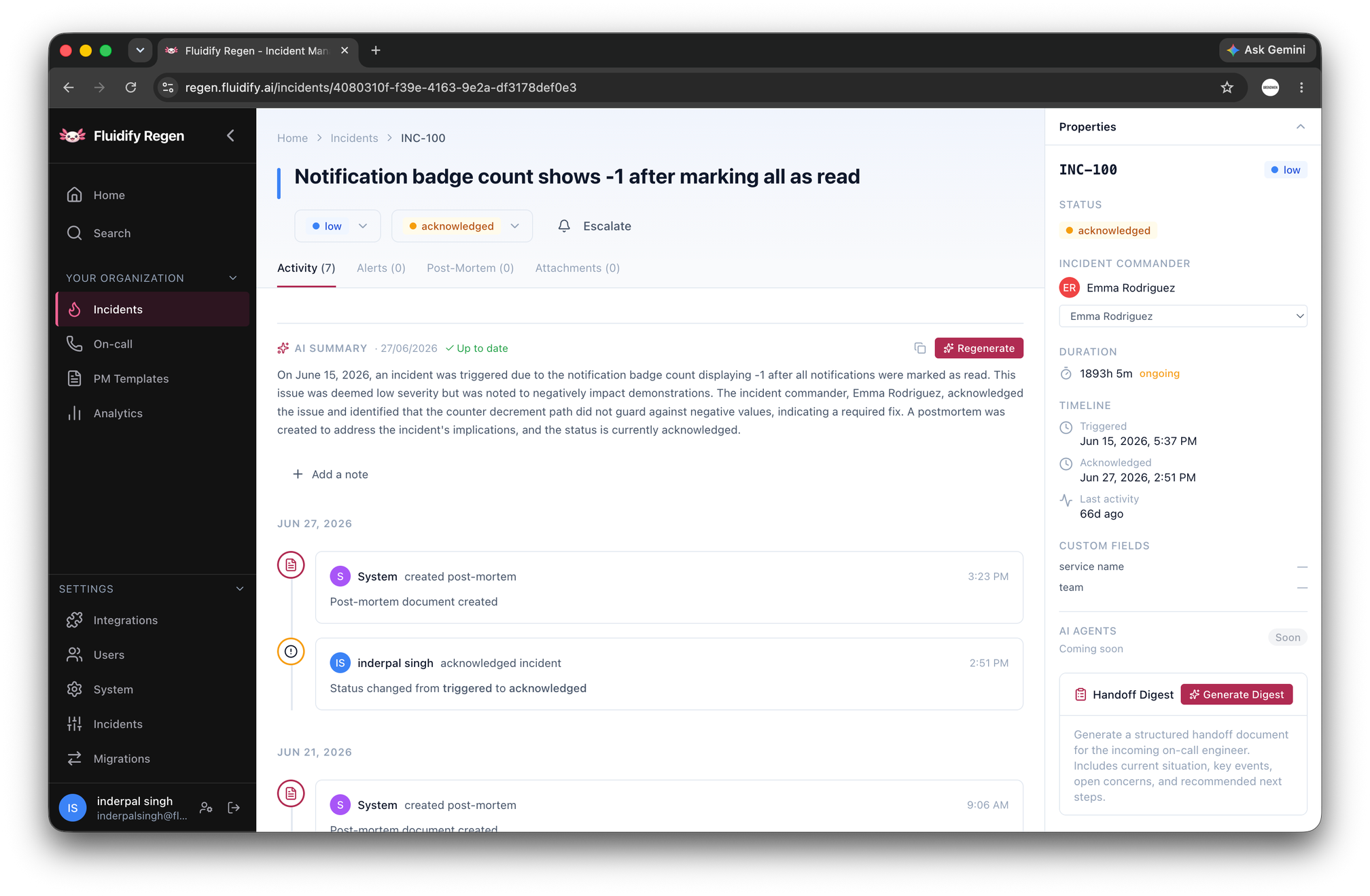
Immutable incident timeline with Slack-synced updates, generated as the incident progresses.
Perfect for: teams already paying Rootly's per-seat bill who want the same
on-call and incident coordination coverage without the headcount-linked pricing, or
who need a genuinely self-hosted option rather than an on-prem connector bolted
onto a SaaS platform.
Notable features
- Alert ingestion from Prometheus Alertmanager, Grafana, AWS CloudWatch, or a
generic webhook, with pattern matching that learns from historical incidents - On-call scheduling with layer-based rotations, overrides, holidays, exceptions,
and leave. Global timezone and multi-language support - Escalation policies with multi-step timeouts
- Immutable incident timelines with bidirectional Slack and Microsoft Teams sync
- AI-generated incident summaries, post-mortems, and handoff digests, using your own
model key. BYOK with OpenAI, Anthropic, or Ollama - SSO/SAML 2.0 with Okta, Azure AD, Google Workspace, or any compliant IdP, included
free - 1-click migration from Grafana OnCall or PagerDuty
Why Regen over Rootly
Rootly's AI SRE features and retrospectives tooling are capable, but they're
metered by the same per-seat pricing as everything else in the platform. Regen
includes AI-generated post-mortems on every tier, including the free self-hosted
one, and doesn't charge more as your team grows. If data residency matters, Regen
deploys self-hosted, VPC, or air-gapped, not just connected to your on-prem systems
from someone else's cloud. Full details on the Regen product
page.
Where it falls short
Self-hosted-first rather than SaaS-first, so a team that specifically wants a fully-managed experience with dedicated enterprise account support gets that more readily from Rootly's own Enterprise tier.
Pricing
Free under AGPLv3 for the self-hosted tier: unlimited users, incidents, and
schedules, includes SSO/SAML and BYOK AI. Managed Cloud starts at $100/month (Pro)
and $200/month (Business, which adds Reflex and Gills on top of Regen and Neuri).
Enterprise is a custom annual contract. No per-user pricing on any tier.
Choose Regen if: your Rootly bill is driven by headcount rather than incident
volume, or you need a self-hosted deployment Rootly's Edge Connector doesn't
actually provide.
2. incident.io
Also considered: teams comparing Rootly against a narrower, Slack-native
incident platform.
Notable features
- Slack-native incident declaration, response coordination, and retrospectives
- Automated status page updates tied to incident state
- Post-mortem templates and automatic timeline construction
Where incident.io fits, and where Regen still wins
Both incident.io and Rootly are SaaS, per-seat, feature-rich incident platforms.
Regen matches incident.io's Slack-native coordination, includes on-call in the same
price instead of a separate add-on, and adds AI-generated post-mortems neither
Rootly nor incident.io's templates produce.
Where it falls short
On-call scheduling is a separate add-on, not included in the base price. No
AI-generated post-mortems, templates still require a human to fill them in.
Pricing
Team plan from $15 to $19/user/month depending on billing term, plus roughly $12 to
$20/user/month more for on-call. Enterprise is custom.
Choose Regen instead if: you want Rootly's SaaS convenience without per-seat
pricing or a post-mortem a human still has to write.
3. FireHydrant
Also considered: larger organizations comparing Rootly against a
process-standardization specialist.
Notable features
- Automated incident role assignment and runbook execution
- Retrospective workflows with configurable templates
- Status page and stakeholder communication tooling
Where FireHydrant fits, and where Regen still wins
FireHydrant's specific strength is process standardization at scale: automated
role assignment and runbook execution. Regen's escalation policies and immutable
timelines enforce the same consistency at any team size, without FireHydrant's
mid-market contract pricing or its missing AI post-mortems.
Where it falls short
Pricing and contract size are built for mid-market and enterprise, starting around $10,000 to $25,000/year on Pro. AI-generated retrospectives are Enterprise-tier only. No self-hosted option.
Pricing
Free for up to 10 responders. Past that, Pro runs $25 per responder monthly, billed annually, and Vendr's tracked median annual contract is $33,195.
Choose Regen instead if: your incident process needs enforcement across teams,
but a five-figure annual contract isn't the way you want to get there.
4. Hyperping
Also considered: small teams comparing Rootly against a much lighter,
flat-priced bundle.
Notable features
- HTTP, TCP, DNS, SSL, ICMP, cron, and browser-based monitoring
- On-call escalation chains via Slack, SMS, phone, email, and webhook
- Status pages on a custom domain, included even on lower-cost plans
Where Hyperping fits, and where Regen still wins
Hyperping is priced flat by monitor count, not team size, meaningfully cheaper
than Rootly for small teams. Its on-call side stops at fixed escalation chains, no
rotation scheduling, no incident timeline, no AI post-mortem, the exact gap Regen
fills at no per-seat cost either.
Where it falls short
No AI-assisted investigation or post-mortem generation. No incident coordination or
runbook layer beyond getting someone paged.
Pricing
Free plan for testing. Essentials from $24/month, Pro at $74/month (adds phone
alerts), Business at $249/month (adds SSO, audit logs, compliance features).
Choose Regen instead if: you want a lighter bundle than Rootly that still
includes real on-call scheduling and AI post-mortems.
5. PagerDuty
Also considered: large organizations comparing Rootly against a dedicated,
narrower on-call platform.
Notable features
- Mature on-call scheduling and escalation policies
- Broad third-party integration ecosystem
- AIOps and Advance tiers as separate add-on products
Where PagerDuty fits, and where Regen still wins
PagerDuty is more narrowly focused on alerting and escalation than Rootly's
broader incident-lifecycle platform, same as Regen. The difference is Regen
doesn't charge per seat and includes AI-generated post-mortems PagerDuty's base
product doesn't have.
Where it falls short
Per-seat pricing that compounds with every hire, the same structural issue as
Rootly. No self-hosted option. No AI-generated post-mortems included in the base
product.
Pricing
Starts at about $21/user/month, with AIOps and Advance sold as separate add-ons.
Choose Regen instead if: you want a dedicated on-call platform without the
per-seat bill or the missing AI post-mortems.
6. Squadcast
Also considered: SRE-focused teams comparing Rootly against a
SLO-and-error-budget specialist.
Notable features
- Automated escalations with multi-channel alerting
- Alert deduplication, suppression, and grouping to cut noise
- SLO tracking with error budget monitoring
- ServiceNow bidirectional sync (Enterprise tier)
Where Squadcast fits, and where Regen still wins
Squadcast leans further into SRE workflow, SLOs and error budgets specifically,
than Rootly does. Its Reliability AI is ML-driven incident intelligence, not a
generated post-mortem, and it still bills per seat. Regen covers the core
incident lifecycle at a fraction of the cost, with Neuri alongside it for the
root-cause work Squadcast's tooling targets.
Where it falls short
Per-seat pricing, same as Rootly. Reliability AI is ML-driven incident
intelligence, not AI-generated post-mortems. No self-hosted option.
Pricing
Free tier available (5 users). Pro at $20/user/month ($15/user annually), Premium
at $29/user/month ($24/user annually), Enterprise custom.
Choose Regen instead if: SLO and reliability work matter to your team but
per-seat pricing isn't how you want to get there.
A note on Better Stack
Better Stack also comes up frequently as a Rootly alternative. It bundles
monitoring, on-call, and status pages with an AI investigation agent. It's covered
in full depth in a separate comparison
on this blog rather than repeated here.
Head-to-head decisions
Regen versus incident.io: same general capability set, but Regen has no per-seat
pricing and a self-hosted option. incident.io is SaaS-only with on-call billed
separately from the base price.
Regen versus FireHydrant: FireHydrant's process enforcement is a narrower
specialty. Regen covers the same standardization need through consistent
escalation policies and immutable timelines, at any team size, and adds
AI-generated post-mortems and no per-seat contract on top.
Regen versus Squadcast: Squadcast's SLO and error-budget tooling is more
specialized, but Regen covers the core incident lifecycle at a fraction of the
per-seat cost and adds AI post-mortems Squadcast doesn't have. Neuri,
the root-cause product in the same suite as Regen, covers the MTTR reduction
Squadcast's Reliability AI is aimed at.
Decision framework
By team size
Under 20 people: Regen, free self-hosted with no seat limits and more capability
than a flat-rate paging tool. 20 to 100 people: Regen, no per-seat pricing means
the math gets more favorable as headcount grows, not less. 100+ people: Regen,
the same cost as a 5-person rotation, with escalation policies and immutable
timelines standardizing process the same way a dedicated enforcement tool would.
By workflow
Slack-native coordination: Regen, bidirectional sync with Slack and Microsoft
Teams. SRE and SLO-focused: Regen plus Neuri for root cause analysis. Process
enforcement across many teams: Regen's escalation policies and timelines.
By budget (20-person team, annual)
Regen: $0 self-hosted, or $1,200 to $2,400/year on Pro or Business managed. Hyperping: $288 to $2,988/year depending on tier. PagerDuty: about $5,040/year. Squadcast: about $3,600 to $6,960/year. incident.io: about $3,600 to $4,560/year, plus on-call add-on. Rootly: $15,000 to $30,000/year on Essentials with On-Call. FireHydrant: about $6,000/year on Pro for 20 responders, or free under 10.
Full list of Rootly alternatives considered
| Tool | Pricing model | Self-hosted |
|---|---|---|
| FluidifyAI Regen | Free, no per-seat managed tiers | Yes |
| incident.io | Per-user | No |
| FireHydrant | Per-responder | No |
| Hyperping | Flat, per-monitor | No |
| PagerDuty | Per-user | No |
| Squadcast | Per-user | No |
| Better Stack | Per-responder (on-call) | No |
| Opsgenie | Per-user | No |
| xMatters | Per-user | No |
| Grafana OnCall | Free, archived March 2026 | Yes |
| GoAlert | Free | Yes |
Common mistakes when leaving Rootly
Comparing sticker prices without adding on-call. Several alternatives here
(incident.io, and Rootly itself) price incident response and on-call separately.
The number on the pricing page isn't the number on the invoice.
Assuming "connects to on-prem" means self-hosted. Rootly's Edge Connector reaches
on-premise systems, but the platform of record stays in Rootly's cloud. If data
residency is the actual requirement, confirm a tool is genuinely self-hostable, not
just able to integrate with your infrastructure.
Not modeling the price at next year's headcount. Every per-seat tool on this list
gets more expensive as you hire. Model the cost at your expected team size in 12
months, not just today's.
FAQ
What's the best Rootly alternative?
FluidifyAI Regen. It covers the same incident lifecycle, on-call, escalation,
retrospectives, without per-seat pricing, without being SaaS-only, and with
AI-generated post-mortems included rather than metered.
Why do teams look for Rootly alternatives?
Mostly cost structure: per-seat pricing that compounds with headcount, with most
teams landing between $15,000 and $60,000/year once on-call is added, and the lack
of a genuinely self-hosted option for teams with data residency requirements.
Is Rootly worth the cost?
For most teams, no. The on-call, incident lifecycle, and AI post-mortem work
Rootly charges $15,000 to $60,000/year for is the same ground Regen covers for
free self-hosted or $1,200/year managed, without the per-seat pricing. Full
pricing breakdown if you want the numbers at your own team size.
Try Regen against your own incidents
The self-hosted community edition is on GitHub,
running in a few minutes via Docker Compose. Talk to us if you'd rather
walk through a migration from your current Rootly setup first.
A note on pricing: the rates referenced above reflect each vendor's publicly published pricing as of October 2026. Vendors change pricing without much notice, so confirm current rates on the vendor's own pricing page before making a purchasing decision.