

Key takeaways
- Better Stack bundles logs, infrastructure monitoring, uptime, status pages, and
on-call into one platform. On-call pricing rides on top of a bigger observability
bill, and there's no self-hosted option. - FluidifyAI Regen is the stronger alternative for teams whose actual need is
on-call and incident management, not full-stack observability: no per-seat
pricing, a real open-source and self-hosted option, and AI post-mortems included
rather than metered. - Datadog and PagerDuty solve the same on-call problem at a much higher price
point, and incident.io and Hyperping cover only a narrower slice of it. None of
the four match Regen on price, deployment flexibility, or included AI post-mortems.
Why teams look for Better Stack alternatives
Better Stack's pitch, one platform instead of five, holds up until you look at what
happens to the bill once you add on-call. The free tier caps out fast: 10 monitors,
3GB of logs. On-call pricing starts at $29 per responder per month on top of
whatever observability tier you're already paying for. There's also no self-hosted
option. Whatever your data residency requirements are, Better Stack's cloud is the
only place your incidents live.
None of that makes Better Stack a bad product. It means teams evaluating
alternatives usually fall into one of two groups: those who want a cheaper or more
flexible way to get the same bundled experience, and those who realize they don't
need the observability half at all and just want on-call and incident management
done well, without paying for logs and infrastructure monitoring they already have
somewhere else.
Top picks at a glance
- Best overall: FluidifyAI Regen. Full incident lifecycle, AI post-mortems, no
per-seat pricing, self-hosted or SaaS.
Quick comparison
| Tool | Starting price | Best for | Main limitation |
|---|---|---|---|
| FluidifyAI Regen | Free (AGPLv3), $100/mo managed | Incident lifecycle plus AI post-mortems, no per-seat pricing | No built-in observability |
| Datadog | $50 to $200/user/mo for on-call and incident products | Teams already paying for Datadog observability | Among the most expensive options here at any real headcount |
| PagerDuty | About $21/user/mo, rising per tier | Enterprise-scale on-call standardization | Per-seat pricing that compounds with every hire |
| incident.io | $15 to $19/user/mo, on-call billed separately | Slack-native incident coordination | On-call isn't included in the base price |
| Hyperping | Free to $249/mo flat, no per-user fee | Small teams wanting monitoring, on-call, and status pages cheaply | No AI assist, no incident coordination layer |
1. FluidifyAI Regen
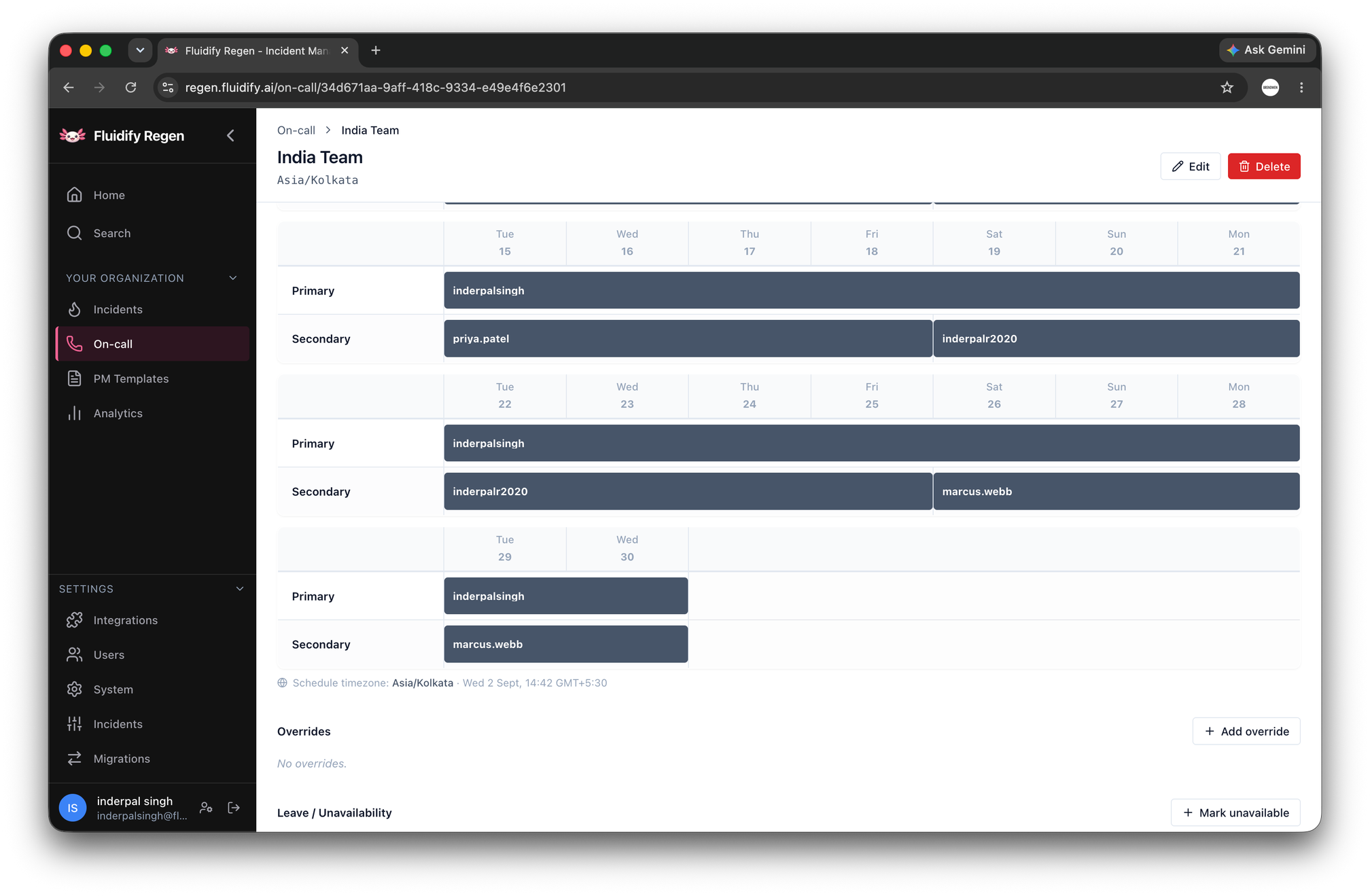
Layer-based on-call rotations with escalation policies, configured entirely in the self-hosted UI.
Who Regen is built for
Teams evaluating Better Stack alternatives who realize the observability half of
the bundle isn't what they're actually shopping for. What they want is on-call,
escalation, and incident coordination done well, without a per-seat bill that grows
with headcount and without being locked into one vendor's cloud.
Key Regen features
FluidifyAI Regen is an open-source on-call and incident management platform
covering alerting, alert routing, on-call scheduling, escalations, and AI assist:
- Alert ingestion from Prometheus Alertmanager, Grafana, AWS CloudWatch, or a
generic webhook, with pattern matching that learns from historical incidents - On-call scheduling with layer-based rotations, overrides, holidays, exceptions,
and leave. Global timezone and multi-language support included - Escalation policies with multi-step timeouts
- Immutable incident timelines with bidirectional Slack and Microsoft Teams sync:
channels, bot commands, and Adaptive Cards - AI-generated incident summaries, post-mortems, and handoff digests, using your own
model key. BYOK with OpenAI, Anthropic, or Ollama - SSO/SAML 2.0 with Okta, Azure AD, Google Workspace, or any compliant IdP, included
free - Telegram, push notification, and mobile app delivery for on-call alerts
- 1-click migration from Grafana OnCall or PagerDuty
Why Regen over Better Stack
Better Stack makes sense if you genuinely want logs, infrastructure monitoring, and
on-call from one vendor. If you don't, if your monitoring stack is already
Prometheus, Grafana, Datadog, or CloudWatch, and what you actually need is what
sits on top of that (paging, on-call, incident coordination, and a post-mortem you
didn't have to write yourself), Regen does that specific job without billing you
for observability you didn't ask for. It also deploys self-hosted, which Better
Stack doesn't offer at any price. Full details are on the Regen product
page.
How it holds up in practice
Because there's no per-seat pricing on any tier, a 200-person on-call rotation
costs the same as a 10-person one. Datadog, PagerDuty, and incident.io all bill per
user, so their price scales with headcount even when incident volume doesn't.
How much Regen costs
Free under AGPLv3 for the self-hosted tier: unlimited users, incidents, and
schedules, includes SSO/SAML and BYOK AI. Managed Cloud starts at $100/month (Pro)
and $200/month (Business, which adds Reflex and Gills on top of Regen and
Neuri). Enterprise is a custom annual contract. No per-user pricing on
any tier.
Where it falls short
The mobile app and higher-volume managed AI features beyond BYOK are gated to paid
tiers, not the free self-hosted plan. Doesn't include native logging the way
Better Stack does.
2. Datadog
Also considered: organizations already paying for Datadog observability who
assume adding its on-call product is the path of least resistance.
Key Datadog features
- Full observability suite: infrastructure monitoring, APM, log management, RUM,
security - On-Call and Incident Management products, purchasable standalone or bundled at a
discount - Deep integration between telemetry and incident context
Where Datadog fits, and where Regen still wins
Being a Datadog customer for observability doesn't require using their on-call
product too. Regen ingests alerts from Datadog the same as any other source, so
you keep the observability platform and add on-call, escalation, and AI-generated
post-mortems without the per-user pricing Datadog's incident tooling carries.
How it holds up in practice
Datadog's pricing model is the most frequently cited pain point in independent
breakdowns of the product: costs that compound as you add hosts, custom metrics,
and log volume, on top of per-seat on-call pricing layered on that base.
How much Datadog costs
On-Call and Incident Management pricing runs $50 to $200 per user per month
depending on tier, with a discount if purchased together as "Incident Response."
That's before the underlying observability platform, billed separately by hosts,
logs, and custom metrics.
Where it falls short
Among the most expensive options on this list at any real headcount, per-seat
on-call pricing on top of a large, separately-billed observability platform. No
self-hosted option. Overkill if on-call and incident coordination is the actual
need, not full-stack observability.
3. PagerDuty
Also considered: large organizations comparing Better Stack's bundle against a
dedicated, unbundled on-call platform.
Key PagerDuty features
- Mature on-call scheduling and escalation policies
- Broad third-party integration ecosystem
- AIOps and Advance tiers as separate add-on products
Where PagerDuty fits, and where Regen still wins
PagerDuty is a dedicated on-call and incident response platform, not a bundled
observability product, same as Regen. The difference is Regen doesn't charge per
seat, includes AI-generated post-mortems PagerDuty's base product doesn't have,
and deploys self-hosted if PagerDuty's cloud-only model is a problem.
How it holds up in practice
PagerDuty's pricing is easy to model precisely because it's so consistently
per-seat: the bill is a direct function of headcount, independent of how many
incidents a team actually handles.
How much PagerDuty costs
Starts at about $21/user/month, with AIOps and Advance sold as separate add-ons.
Where it falls short
Per-seat pricing that grows every time you hire, the same structural problem this
whole comparison exists to solve. No self-hosted option. No AI-generated
post-mortems.
4. incident.io
Also considered: Slack-native teams comparing Better Stack's bundle against a
narrower, coordination-first tool.
Key incident.io features
- Slack-native incident declaration and response coordination
- Automated status page updates tied to incident state
- Post-mortem templates and automatic timeline construction
Where incident.io fits, and where Regen still wins
incident.io focuses on the incident lifecycle rather than bundling observability,
a narrower, more focused product than Better Stack's all-in-one approach. Regen
matches that focus and syncs with Slack too, but includes on-call in the same
price instead of a separate add-on, plus AI-generated post-mortems incident.io's
templates don't produce.
How it holds up in practice
The base pricing on incident.io's plans covers incident response only. On-call
scheduling is a separate add-on that adds a meaningful amount to the effective
per-user cost, easy to miss when comparing sticker prices.
How much incident.io costs
Team plan from $15 to $19/user/month depending on billing term, plus roughly $12 to
$20/user/month more for on-call. Enterprise is custom.
Where it falls short
On-call isn't included in the base price. No AI-generated post-mortems, templates
still need a human to fill them in. Per-user pricing scales with headcount the same
way PagerDuty's does.
5. Hyperping
Also considered: small teams comparing Better Stack's bundle against a
cheaper, flat-rate version of the same shape.
Key Hyperping features
- HTTP, TCP, DNS, SSL, ICMP, cron, and browser-based monitoring
- On-call escalation chains via Slack, SMS, phone, email, and webhook
- Status pages on a custom domain, included even on lower-cost plans
Where Hyperping fits, and where Regen still wins
Hyperping covers a similar bundle at meaningfully lower cost than Better Stack,
priced flat by monitor count instead of team size or log volume. Its on-call side
still stops at fixed escalation chains: no rotation scheduling, no incident
timeline, no AI post-mortem, exactly what Regen adds on top of it.
How it holds up in practice
Hyperping's flat, monitor-based pricing is the most straightforward to predict of
any tool on this list. A 50-person team costs exactly what a 5-person team costs,
the opposite of every per-seat tool here.
How much Hyperping costs
Free plan for testing. Essentials from $24/month, Pro at $74/month (adds phone
alerts), Business at $249/month (adds SSO, audit logs, compliance features).
Where it falls short
No AI-assisted investigation or post-mortem generation. No incident coordination
layer beyond getting someone paged. Phone alerts and higher check frequency are
gated to higher tiers.
All Better Stack alternatives
| Name | Pricing model | Main strength | Main weakness |
|---|---|---|---|
| FluidifyAI Regen | Free (AGPLv3), $100 to $200/mo managed, no per-seat pricing | Full incident lifecycle plus AI post-mortems included | No built-in observability, pairs with your monitoring stack |
| Datadog | $50 to $200/user/mo for on-call, plus separate observability billing | Deepest observability integration | Most expensive option here at scale |
| PagerDuty | About $21/user/mo, rising per tier | Broadest integration ecosystem | Per-seat pricing compounds with headcount |
| incident.io | $15 to $19/user/mo plus on-call add-on | Slack-native coordination | On-call billed separately |
| Hyperping | Free to $249/mo flat, no per-user fee | Predictable flat pricing | No AI or coordination layer |
FAQ
What's the main reason teams leave Better Stack?
Usually pricing structure, not the product itself. The free tier is capped
tightly, and on-call pricing is layered on top of a separately-billed observability
platform. Teams that don't need the full observability bundle often find they're
paying for capability they don't use.
Do any of these alternatives include AI-generated post-mortems?
FluidifyAI Regen includes AI-generated post-mortems and incident summaries at no
extra cost, using your own model key. Datadog has AI-assisted investigation as part
of its broader, pricier, platform. PagerDuty, incident.io, and Hyperping leave
post-incident writeup to a human, with templates at best.
Is there a self-hosted alternative to Better Stack?
FluidifyAI Regen is the only tool on this list with a genuine self-hosted,
open-source option (AGPLv3). Datadog, PagerDuty, incident.io, and Hyperping are all
cloud-only.
How much cheaper is Regen than Better Stack at scale?
Because Regen has no per-seat pricing on any tier, the gap widens with headcount. A
200-person rotation on Regen's managed Business tier ($200/month flat) versus
Better Stack's per-responder on-call pricing starting at $29/responder/month scales
very differently as a team grows.
Do I need to replace my monitoring stack to use Regen?
No. Regen ingests alerts from whatever you already use: Prometheus Alertmanager,
Grafana, CloudWatch, or a generic webhook. It's built to sit on top of existing
monitoring, not replace it, the opposite of Better Stack's all-in-one model.
Can I migrate from Better Stack directly?
Not via 1-click migration. That tooling covers Grafana OnCall, Opsgenie, and
PagerDuty specifically. Moving off Better Stack's on-call product means recreating
escalation policies and schedules directly in Regen's UI, which is straightforward
since Better Stack's on-call configuration is simple to begin with.
How to test these tools
Whichever alternative you're evaluating, the same checklist applies: run a real
on-call rotation through it for at least one full cycle, not a demo. Check what
happens to the price at your actual team size in a year. Confirm what happens to
your data if you ever want to leave. Self-hosted tools like Regen, available on
GitHub, answer that last question by default,
since you already have the data.
Not sure which of these fits your stack? Talk to us about moving off
Better Stack's on-call product, or see the full pricing breakdown for
Regen.
A note on pricing: the rates referenced above reflect each vendor's publicly published pricing as of October 2026. Vendors change pricing without much notice, so confirm current rates on the vendor's own pricing page before making a purchasing decision.