

PagerDuty's pricing is built around seats: pay per responder, and the bill grows every
time you hire. For a 50-person on-call rotation on Business tier, that's easily
$2,000 a month before you've added AIOps or Advance as separate line items, and
that's before you've even looked at what the AI layer actually does. Most
"alternatives" lists just swap one per-seat SaaS bill for a slightly smaller one. This
one includes those, but the tool that actually solves the problem, no per-seat
pricing, a real self-hosted option, and AI post-mortems that don't cost extra, is
FluidifyAI Regen. Here's how it and nine others stack up.
Quick comparison
| Tool | Type | Starting price | Best for |
|---|---|---|---|
| FluidifyAI Regen | Open source / self-hosted / SaaS | Free (AGPLv3), $100/mo managed | The best overall PagerDuty alternative: full incident lifecycle, AI post-mortems, no per-seat pricing |
| incident.io | SaaS | $15 to $19/user/mo (on-call billed separately) | Teams that want incident response unified with Slack, and don't mind paying extra for on-call |
| Opsgenie | SaaS | About $9.45/user/mo | Atlassian-stack teams |
| Better Stack | SaaS | Free tier, on-call from $29/responder/mo | Teams that want observability and on-call in one product |
| FireHydrant | SaaS | Free up to 10, then $25/responder/mo | Teams standardizing incident process at scale |
| xMatters | SaaS | About $9/user/mo | Mid-sized teams wanting workflow automation |
| Hyperping | SaaS | Free to $249/mo flat (no per-user fee) | Small teams wanting monitoring, on-call, and status pages for one flat price |
| Grafana OnCall | Open source (archived) | Free (AGPLv3) | Existing users only, repository archived, not for new adoption |
| GoAlert | Open source | Free (Apache 2.0) | Teams that want pure paging/escalation and nothing more |
| OneUptime | Open source / self-hosted / SaaS | Free self-hosted, cloud from $1/mo per monitor | Teams that want monitoring, status pages, and on-call in one open-source tool |
1. FluidifyAI Regen
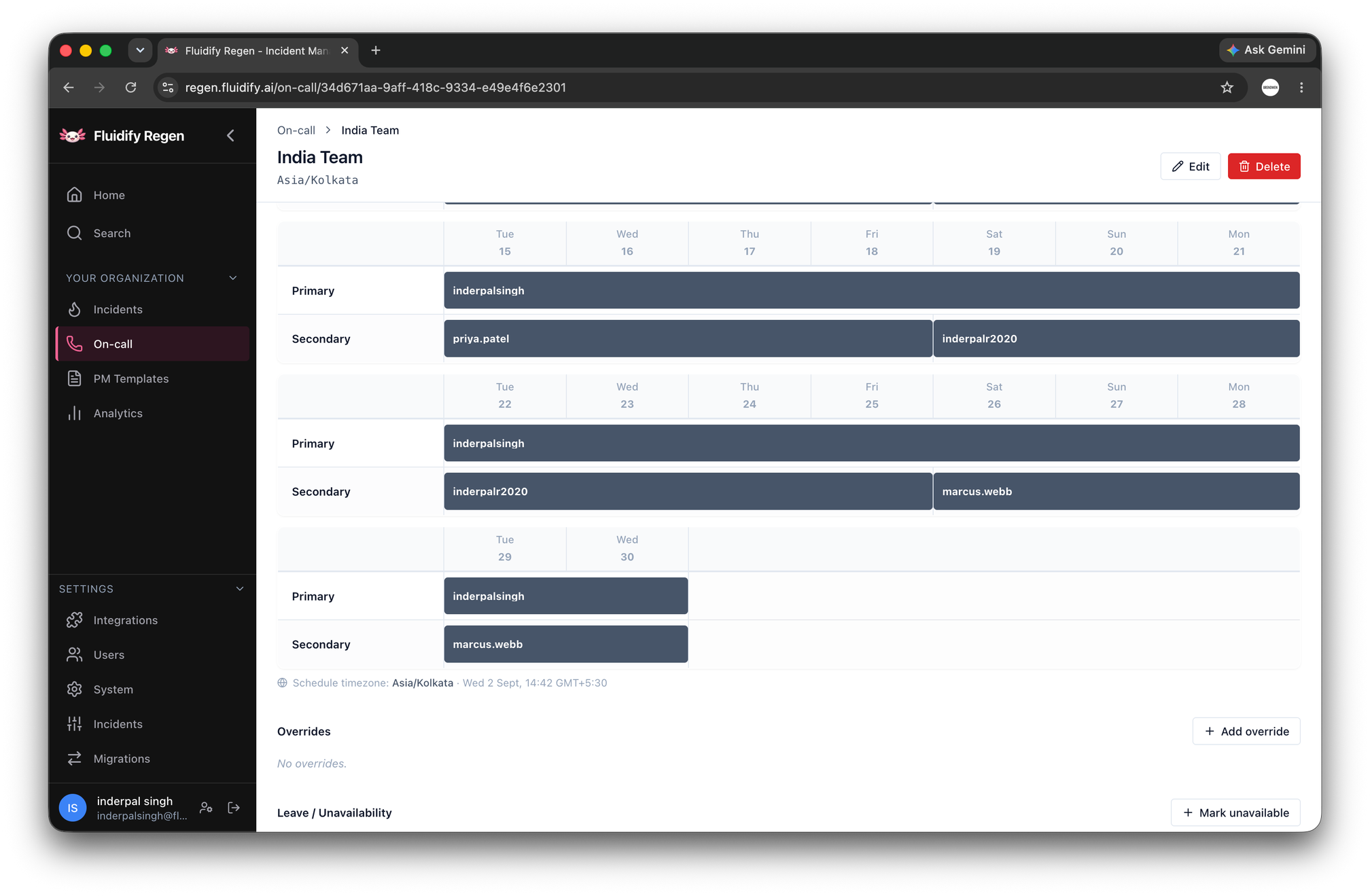
Layer-based on-call rotations with escalation policies, configured entirely in the self-hosted UI.
FluidifyAI Regen is an open-source on-call and incident management platform covering
alerting, alert routing, on-call scheduling, escalations, and AI assist: the parts
of PagerDuty, incident.io, and Grafana OnCall that most teams end up needing, without
three separate bills. It deploys as SaaS, self-hosted, VPC, or air-gapped, via a
single Docker Compose file in under five minutes if you're self-hosting, and it
keeps going through the whole incident: timeline, diagnosis handoff, and the
post-mortem that usually gets skipped because nobody has time to write it after the
fact.
Regen is one piece of FluidifyAI's broader AI SRE Suite.
Neuri owns root cause analysis, Reflex owns fixing the issue, and Gills
owns communicating with the wider org. Regen's job is specifically getting the right
person paged and coordinating everything from the alert firing through the incident
closing: creation, commander assignment, communication, and collaboration.
Key capabilities
- Alert ingestion from Prometheus Alertmanager, Grafana, AWS CloudWatch, or a generic webhook, with pattern matching that learns from historical incidents
- On-call scheduling with layer-based rotations, overrides, holidays, exceptions, and leave, with global timezone and multi-language support
- Escalation policies with multi-step timeouts, so an unacknowledged alert never just sits
- Immutable incident timelines with bidirectional Slack and Microsoft Teams sync: channels, bot commands, and Adaptive Cards, not just one-way notifications
- AI-generated incident summaries, post-mortems, and handoff digests, synced straight to Slack/Teams, using your own model key (BYOK: OpenAI, Anthropic, or Ollama)
- SSO/SAML 2.0 with Okta, Azure AD, Google Workspace, or any compliant IdP, included in the free tier, not a paid add-on
- Telegram, push notification, and mobile app (iOS/Android) delivery for on-call alerts
- 1-click migration from Grafana OnCall, Opsgenie, or PagerDuty, with schedules and escalation policies carrying over directly
- Deploys in under five minutes via Docker Compose or Kubernetes, as simple to stand up as a single-purpose pager, without being limited to one
Strengths
- Full incident lifecycle in one platform. Most of this list either pages
(GoAlert, Hyperping) or coordinates (incident.io, FireHydrant), not both - Only tool on this list with AI-generated post-mortems included, not a paid add-on
- AGPLv3 community edition is feature-complete, not a crippled trial of the paid tier: unlimited users, incidents, and schedules, with no seat-based limits on any tier
- No per-seat pricing on any tier. A 200-person rotation costs the same as a
10-person one, unlike every SaaS tool on this list - A direct migration path, not just conceptually possible but 1-click, for teams displaced by the Grafana OnCall archival
Limitations
- Smaller niche community
- The mobile app and higher-volume managed AI features (beyond BYOK) are gated to paid tiers
Pricing
Free under AGPLv3 for the self-hosted tier: unlimited users, incidents, and
schedules, includes SSO/SAML and BYOK AI. Managed Cloud starts at $100/month (Pro)
and $200/month (Business, which adds Reflex and Gills on top of Regen and Neuri),
with Enterprise on a custom annual contract. No per-user pricing on any tier. Teams
typically save somewhere around $50,000/year versus a per-seat competitor at
100-engineer scale.
2. incident.io
incident.io focuses exclusively on the incident lifecycle rather than trying to be an
observability platform too: shift coordination, direct response, status
communication, and retrospectives. It's Slack-native, most of the workflow happens
as slash commands and threads rather than a separate dashboard. What it doesn't do is
on-call: that's billed as a separate add-on, so the sticker price is only part of
the real cost. Regen syncs with Slack the same way and includes on-call in the same
price, plus AI-generated post-mortems incident.io's templates don't produce.
Key capabilities
- Slack-native incident declaration, response coordination, and retrospectives
- Automated status page updates tied to incident state
- Post-mortem templates and automatic timeline construction
Strengths
- Minimal context-switching if your team already lives in Slack
- Strong retrospective/post-mortem tooling out of the box
Limitations
- On-call scheduling isn't included. It's a separate add-on that adds
$12 to $20/user/month on top of the base price - Per-user pricing scales with headcount the same way PagerDuty's does, so the
savings versus PagerDuty are smaller than they look on the pricing page - No AI-generated post-mortems. Templates still require a human to fill them in
Pricing
Team plan from $15 to $19/user/month depending on billing term. On-call scheduling is
a separate add-on that adds roughly $12 to $20/user/month on top. Enterprise is
custom.
3. Opsgenie
Opsgenie is Atlassian's on-call and alerting product, and it shows: the deepest
integrations here are with Jira, Confluence, and the rest of the Atlassian stack.
Regen's SSO/SAML works with Okta, Azure AD, or any compliant identity provider,
Atlassian included, without Opsgenie's per-seat pricing, and Regen's 1-click
migration covers Opsgenie directly if you're moving off it.
Key capabilities
- On-call scheduling and escalation policies
- Native Jira Service Management integration
- Alert deduplication and routing rules
Strengths
- Most generous free tier of the mainstream SaaS options
- Deep, first-party integration with Atlassian tooling
Limitations
- Integrations outside Atlassian's own tools are noticeably shallower than
dedicated tools - No AI-assisted diagnosis or post-mortem generation
- Per-seat pricing means the bill still grows with headcount, just more slowly than PagerDuty's
Pricing
Free tier available. Paid plans start around $9.45/user/month.
4. Better Stack
Better Stack is a full observability platform: logs, infrastructure monitoring,
error tracking, uptime, status pages, with on-call and an AI investigation agent
built on top. The pitch is that the AI works better because it shares a platform
with the telemetry, instead of bolting onto tools it doesn't natively understand.
Regen ingests alerts from whatever observability platform you already run,
Better Stack included, and adds on-call plus AI-generated post-mortems, not just
investigation output, without the per-responder pricing.
Key capabilities
- Combined logs, metrics, traces, uptime monitoring, and on-call in one platform
- AI-assisted root cause investigation using native telemetry
- Built-in status pages and incident communication
Strengths
- One platform instead of stitching together separate monitoring and paging tools
- Positioned well below Datadog-scale pricing for comparable observability depth
Limitations
- On-call is bundled with a broader observability platform, real overhead if
paging is all you actually need - Free tier is capped tightly enough (10 monitors, 3GB logs) that most teams outgrow
it quickly, at which point on-call pricing kicks in per-responder - No option to self-host. You're on their cloud either way
Pricing
Free tier for small-scale use. Paid plans with on-call start at $29/responder/month.
5. FireHydrant
FireHydrant is built around process standardization: runbooks, automated incident
roles, and retrospective workflows enforced consistently across every incident,
which matters more once an org has enough teams that "how we handle incidents"
starts to vary team to team. Regen's escalation policies and immutable timelines
enforce the same consistency at any team size, without FireHydrant's mid-market
contract pricing or its missing AI post-mortems.
Key capabilities
- Automated incident role assignment and runbook execution
- Retrospective workflows with configurable templates
- Status page and stakeholder communication tooling
Strengths
- Strong fit for larger orgs standardizing incident process across many teams
- Charges only for active responders, not read-only stakeholders
Limitations
- Pricing and contract size are built for mid-market/enterprise, a hard sell for small teams, starting around $10,000 to $25,000/year on Pro.
- Process enforcement is the whole pitch, so it's overhead you don't need if your
process is still simple - No AI-generated post-mortems. The templates still need a human to write them
Pricing
Free for up to 10 responders. Past that, Pro runs $25 per responder monthly, billed annually, and Vendr's tracked median annual contract is $33,195.
6. xMatters
xMatters focuses on workflow automation around incident response: connecting
alerting to the rest of your operational tooling rather than just routing pages.
Most teams configure a fraction of its 200-plus integrations and pay per-seat for
the rest. Regen handles the on-call and coordination work every team actually
uses, at no per-seat cost, with AI-generated post-mortems xMatters doesn't have.
Key capabilities
- Customizable on-call schedules and escalation workflows
- 200+ integrations for automated incident handling
- Real-time collaboration tooling during active incidents
Strengths
- Free tier plus accessible paid plans for mid-sized teams
- Strong automation surface for connecting incidents to other systems
Limitations
- More complex to configure than simpler paging-only tools, which offsets some of
the automation upside - No AI-assisted diagnosis or automated remediation
- Per-user pricing, so costs climb with every hire the same way PagerDuty's do
Pricing
Free tier available. Paid plans start around $9/user/month.
7. Hyperping
Hyperping bundles monitoring, on-call, and status pages into flat-rate plans priced
by monitor count rather than team size, the opposite pricing model from every other
SaaS tool on this list. Its on-call side stops at fixed escalation chains: no
rotation scheduling, no incident timeline, no AI post-mortem, exactly the gap Regen
fills on top of it, also with no per-seat pricing.
Key capabilities
- HTTP, TCP, DNS, SSL, ICMP, cron, and browser-based (Playwright) monitoring
- On-call escalation chains with Slack, SMS, phone, email, and webhook delivery
- Status pages on a custom domain, included even on lower-cost plans
Strengths
- No per-user fees. A 50-person team costs the same as a 5-person team
- Genuinely flat, predictable pricing at every tier
Limitations
- No AI-assisted investigation or post-mortem generation
- Phone alerts and higher check frequency are gated to higher tiers
- No incident coordination or root cause layer. It stops at "someone got paged"
Pricing
Free plan for testing. Essentials from $24/month, Pro at $74/month (adds phone
alerts), Business at $249/month (adds SSO, audit logs, compliance features).
8. Grafana OnCall
Grafana OnCall was, for years, the default answer to "open-source PagerDuty
alternative." Grafana put it into maintenance mode in March 2025, and the repository
was archived on March 24, 2026. Existing deployments keep running, but Cloud
Connection, the feature that routed SMS, phone, and push notifications through
Grafana Cloud, no longer works, and Grafana isn't shipping further fixes beyond
whatever critical CVEs were already patched before the archive date. If you're still
on it, you're on borrowed time.
Key capabilities
- Alert routing and on-call scheduling with escalation chains
- Deep integration with Grafana dashboards and alerting rules (for existing deployments)
Strengths
- Mature codebase with years of production use behind it, for teams already running it
- Tight fit if you were already standardized on Grafana for observability
Limitations
- Repository is archived: no further development, and no fixes beyond what's
already shipped even for future critical CVEs - Cloud Connection notification delivery no longer works; self-hosted users need
to stand up their own SMS/voice provider from scratch - No AI-assisted diagnosis or post-mortem generation, and no active team behind it
to ever add one
Pricing
Free and open source (AGPLv3), usable indefinitely but unsupported. Grafana's
suggested path forward for teams that need continued support is Grafana Cloud IRM, a
separate paid product, the same per-seat trap this whole list is trying to avoid.
9. GoAlert
GoAlert is Target's open-source on-call scheduler, released under the permissive
Apache 2.0 license. It does one thing, paging and escalation, and does it without
much else attached. It ships as a single Docker container backed by Postgres, which
makes it simple to stand up, but simple because it doesn't do much beyond routing the page.
Regen's self-hosted deploy is a comparably single Docker Compose file, in under
five minutes, but keeps going through the incident timeline, AI post-mortem, and
Slack/Teams sync that GoAlert doesn't attempt.
Key capabilities
- Flexible on-call rotations: shift duration, handover time, manual overrides
- Escalation policies that guarantee every alert reaches someone
- SMS and voice call notifications, with one-character SMS reply to acknowledge or close
Strengths
- Genuinely simple to self-host: one container, one database, no message queue to operate
- Apache 2.0, no copyleft obligations if you build on top of it
- Built and used in production by Target, not a hobby project
Limitations
- Paging and escalation only. No incident timeline, root cause analysis, or
post-mortem generation, so the incident itself still gets managed somewhere else - SMS/voice requires your own Twilio account and its per-message/per-minute costs
on top of the "free" tool - No native AI or automation layer, and none planned. It's intentionally a single-purpose tool
Pricing
Free and open source (Apache 2.0). Self-hosting costs are limited to your own
infrastructure and a Twilio account for SMS/voice delivery.
10. OneUptime
OneUptime is a fully open-source observability platform, not open-core, that
bundles monitoring, status pages, on-call scheduling, and incident management into
one product. Every feature in the cloud version exists in the self-hosted one too,
since there's no separate paid tier holding features back. Its on-call and incident
side is one piece of a broader monitoring platform, not the specialized focus Regen
brings, and OneUptime has no AI-generated post-mortem.
Key capabilities
- Uptime and infrastructure monitoring alongside on-call and incident management
- Fair-rotation on-call scheduling with escalation paths
- Public status pages with unlimited subscribers
Strengths
- One tool replaces monitoring, status pages, and on-call, fewer vendors to manage
- Free to self-host with every feature included
- Flat, predictable cloud pricing (from $1/month per monitor) instead of per-seat
Limitations
- Broader scope than a pure paging tool: more surface area to configure if all you
want is on-call - No AI-assisted root cause analysis or automated remediation, and no post-mortem generation
Pricing
Self-host for free with every feature included. Cloud pricing is flat and
usage-based: monitoring from $1/month per active monitor, with on-call and incident
management included for the whole team at no added per-seat cost.
A note on OpenDuty and other abandoned projects
OpenDuty shows up on almost every "open-source PagerDuty alternative" list,
including searches you'll run yourself. It's worth knowing upfront: the team that
built it moved to IBM years ago, the repository hasn't been touched since, and
GitHub has flagged it read-only. An unmaintained paging tool is a liability, not a
free option. It didn't make this list on purpose.
How to choose
| Your situation | Best choice |
|---|---|
| Want on-call management, incident coordination, and AI post-mortems in one platform | FluidifyAI Regen |
| Currently on Grafana OnCall and need a migration path now that it's archived | FluidifyAI Regen |
| Live in Slack and want incident response unified there, without extra on-call add-on costs | FluidifyAI Regen |
| Already standardized on Atlassian tooling | FluidifyAI Regen |
| Want observability and on-call in one platform | FluidifyAI Regen |
| Standardizing incident process across many teams, without an enterprise contract | FluidifyAI Regen |
| Want workflow automation connecting incidents to other systems, without per-seat pricing | FluidifyAI Regen |
| Small team, want flat pricing with no per-user fees | FluidifyAI Regen |
| Want the simplest possible self-hosted setup, deployed in minutes | FluidifyAI Regen |
| Want the most complete open-source incident and on-call platform | FluidifyAI Regen |
FAQ
Which of these are actually open source?
FluidifyAI Regen, Grafana OnCall, GoAlert, and OneUptime are genuinely open source
and self-hostable. incident.io, Opsgenie, Better Stack, FireHydrant, xMatters, and
Hyperping are commercial SaaS products, useful to know since "PagerDuty alternative"
lists often blur that line.
Is self-hosting actually free, or just free of license fees?
License fees are the only thing that's zero. You still pay for infrastructure (a
database, usually a small VM or container) and, for tools like GoAlert that page over
SMS/voice, a carrier account like Twilio. For most teams that's a small fraction of
per-seat SaaS pricing at any real headcount, but it isn't nothing. Regen's Docker
Compose deploy keeps that overhead to close to zero.
Do any of these include AI-assisted root cause analysis or post-mortems?
FluidifyAI Regen is the only one on this list with AI-generated post-mortems included
at no extra cost. Better Stack has AI-assisted investigation, but as part of a much
broader (and pricier) observability platform. Everything else, GoAlert, OneUptime,
Opsgenie, xMatters, FireHydrant, Hyperping, incident.io, leaves post-incident writeup
to a human with a template.
Can I migrate from Grafana OnCall directly?
Yes. FluidifyAI Regen has 1-click migration from Grafana OnCall, Opsgenie, and
PagerDuty. Schedules and escalation policies carry over directly, and it's
self-hosted the same way OnCall was, without inheriting an archived codebase.
Not sure which of these fits your stack? Talk to us about migrating off
Grafana OnCall now that it's archived, see the full pricing breakdown
for Regen, or run the self-hosted community edition
against a real incident before deciding anything.
A note on pricing: the rates referenced above reflect each vendor's publicly published pricing as of October 2026. Vendors change pricing without much notice, so confirm current rates on the vendor's own pricing page before making a purchasing decision.